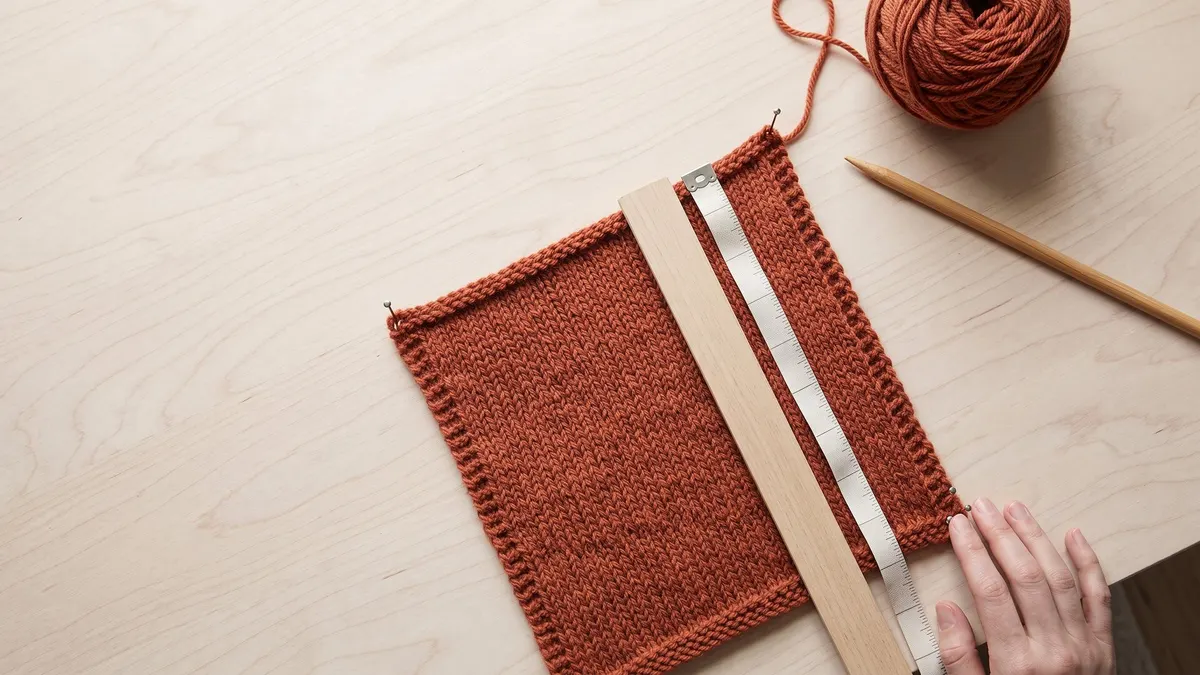
Knitting gauge is the number of stitches and rows you get over a certain measurement – usually over a 4 x 4 in (10 x 10 cm) square. It tells you how tightly or loosely you knit. Check your gauge with our gauge calculator.
A Norwegian version of this page is available on Strikketips.no
Why is it important?
Even if you use the same yarn and needle size as the pattern, your personal knitting style can result in a completely different measurement than the designer's. A gauge swatch is your insurance policy.
If you have too many stitches per 4 in10 cm, you are knitting tighter than the pattern, and the garment will be too small. If you have too few stitches, you are knitting looser, and the garment will be too large.
The arithmetic is unforgiving on large pieces. A sweater body worked over 220 stitches at 22 sts per 4 in10 cm measures 40 in100 cm around. Knit the same 220 stitches at 21 sts — a difference of one single stitch — and you get about 42 in105 cm. Half a stitch off is an inch or two; two stitches off is a different garment. Small pieces forgive you, sweaters do not.
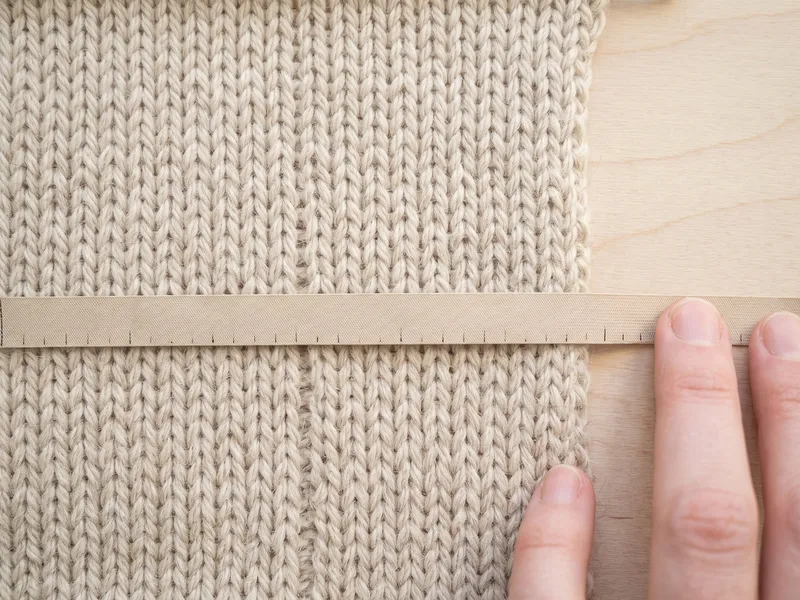
Superwash-treated yarns have a tendency to "sag" or grow significantly when wet. Never measure a superwash gauge swatch before it has been washed and is completely dry. Failing to do so could result in a garment that is several sizes too large after its first wash.
Try the Calculator
Enter your gauge and see if you should change needle size.
Could not save. Your browser may be full or in private mode — write down anything you need, because it will be gone when you reload the page.
Result: Knitting Gauge
Gauge Calculator
Compare your actual knitting gauge with the pattern requirements. Get exact needle size recommendations and custom stitch counts to achieve the perfect fit.
How to make a test swatch that tells the truth
The five points below are the whole method. If your numbers still refuse to line up afterwards, the detailed version — why swatches mislead, how far from the edge to measure, what blocking does to different fibers, and how to swatch in the round — lives alongside the gauge calculator, and the five specific mistakes knitters make are catalogued in gauge errors.
-
Cast on plenty
Cast on about 30-40 stitches. We want to measure the 4 in (10 cm) in the middle, so we need some extra on each side.
-
Knit high enough
Knit about 5–6 in12–15 cm. It's important to see how the yarn behaves over a certain area.
-
Washing is key
Some yarn types grow or shrink in the wash. Wash and dry the swatch before measuring!
-
Measure flat
Lay the swatch on a flat surface. Do not stretch it while measuring.
-
Compare and adjust
Doesn't match the pattern? Switch to larger needles if you have too many stitches, or smaller needles if you have too few (refer to our US to Metric needle size conversion chart). You can also verify expected gauge ranges across standard yarn weight categories.
Stitch Gauge vs. Row Gauge
When you knit a swatch, you actually get two numbers: stitch gauge (the number of stitches per 4 in / 10 cm across the width) and row gauge (the number of rows per 4 in / 10 cm in height). Most knitters only focus on stitch gauge, but row gauge is just as important for the garment's proportions to come out right.
Row gauge determines where raglan shaping, armholes, and necklines land. If your row gauge is far off from the pattern's, the armhole can end up too high or too low even if your stitch gauge matches perfectly. Always knit a swatch tall enough that you can count both numbers accurately.
Blocking by Fiber Type
How yarn behaves when washed varies a lot from fiber to fiber, and this significantly affects your gauge:
| Fibre | Behaviour when washed | What it means for your gauge |
|---|---|---|
| Untreated wool | "Blooms" – stitches even out and fill in small gaps | The swatch can end up slightly wider than before washing |
| Cotton | Little elasticity, may shrink somewhat – especially in length | Row gauge shifts more than stitch gauge |
| Alpaca | Heavy fibre that "grows" noticeably over time | Expect added length after the first wash, especially on larger garments |
| Acrylic and synthetics | Change little when washed, but lose bounce if stretched hard | Stable gauge – block gently, never stretch the swatch |
Always wash and dry your swatch the same way you plan to wash the finished garment, so the measurements you build your project on actually hold up long-term.
Adjusting the Pattern to Your Gauge
Can't get your gauge to match no matter which needles you try? You can instead recalculate the pattern to match your own gauge. This is a bit more advanced, but gives you full freedom to use exactly the yarn and needles you want.
The method is simple math: divide the pattern's stated stitch gauge by your own, then multiply by the number of stitches the pattern tells you to cast on. If the pattern expects 20 stitches per 4 in10 cm but you get 22, the formula is: (20 ÷ 22) × the pattern's stitch count. Do the same for row gauge when calculating lengths.
This method works best for simple constructions without complicated stitch pattern repeats. Check that your adjusted stitch count still works with any repeats (for example, if the pattern requires a multiple of 4 stitches).
Can Needle Material Affect Gauge?
Yes! Even if two needles are exactly the same size in millimeters, they can produce a different gauge. Metal needles are slippery and let stitches slide off easily, which often produces a looser gauge. Wood, bamboo, or carbon needles have more friction, which can produce a slightly tighter gauge because stitches "grip" a little longer.
If you switch needle material mid-project – or between your swatch and the actual garment – knit a new swatch to be safe. If you're unsure what needle size you need after a switch, use our needle conversion chart as a starting point.
Frequently Asked Questions
What do I do if I get too many stitches per 4 in10 cm?
If you have too many stitches, it means you're knitting too tightly. You should switch to larger needles and knit a new gauge swatch.
What do I do if I get too few stitches per 4 in10 cm?
If you have too few stitches, it means you're knitting too loosely. You should switch to smaller needles and knit a new gauge swatch.
Can I measure the gauge while the work is on the needles?
It's best to finish the swatch, cast off, wash, and dry it before measuring. The stitches can change significantly after washing, especially with treated yarns (Superwash).
What's the difference between stitch gauge and row gauge?
Stitch gauge is the number of stitches per 4 in10 cm across the width, while row gauge is the number of rows per 4 in10 cm in height. Stitch gauge determines how wide the garment is, while row gauge determines whether armholes, raglan shaping, and necklines land in the right place.
Do I need to swatch in the round if my project is knit in the round?
Yes, ideally. Many knitters knit slightly differently in the round versus flat, since knitting in the round in stockinette means only ever knitting the stitch, not purling. Swatch the same way you'll knit the project for the most accurate result.
Can needle material (wood, metal, carbon) affect my gauge?
Yes. Metal needles are slippery and often produce a looser gauge, while wood and bamboo needles have more friction and can give a tighter gauge. If you switch materials, knit a new swatch.
How do I adjust a pattern if I can't match the gauge?
Divide the pattern's stated gauge by your own, then multiply the result by the number of stitches the pattern tells you to cast on. That gives you a stitch count adjusted to your gauge. Double-check the adjusted number still works with any stitch pattern repeats.
Gauge is measured over 4 in10 cm and yarn weight categories are named according to the Craft Yarn Council's Standard Yarn Weight System, the convention used by US pattern publishers.