Once you've learned to knit stitches, the next natural step is to learn the purl stitch. Purling can feel more awkward than knitting at first; it gets easier with practice.
What is a purl stitch?
Actually, a purl stitch is just the back side of a knit stitch! If you knit a stitch and turn your work around, it will look like a purl stitch (often described as having a small "bump" or "collar"). When you combine knit and purl stitches, you can create endless patterns, such as stockinette stitch, ribbing, or seed stitch.
Step-by-step: How to purl
Yarn in front
The working yarn hangs in front of the needle, toward you. This is the one thing that changes.
Insert
Enter the first stitch from right to left, back to front.
Wrap
Take the yarn counterclockwise around the right needle tip, in front of the work.
Push through and drop
Push the new loop backwards through the old stitch, then let the old stitch slide off.
The purl stitch is the knit stitch worked from the other direction. Note where the yarn sits — that is the whole difference.
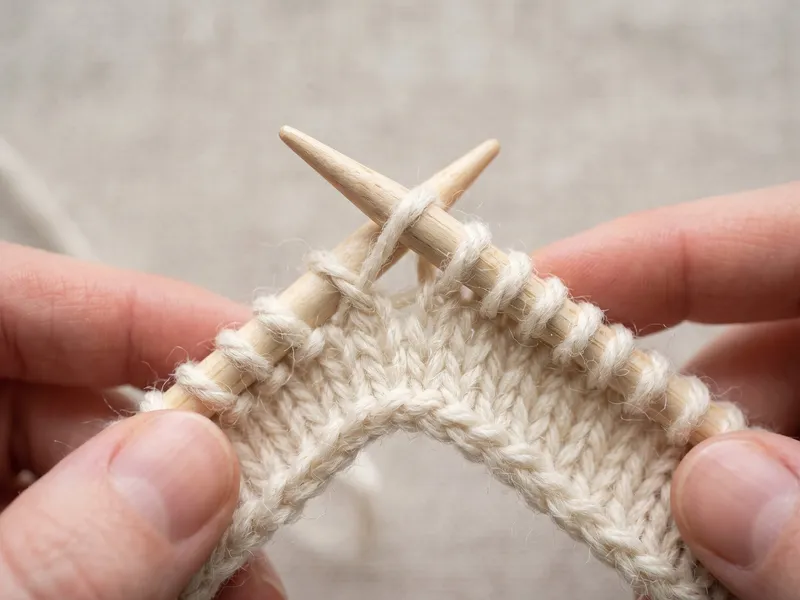
Step 1: Yarn in front
The most important thing when purling is that your working yarn must be in front of your work (facing you).
Step 2: Insert the needle
Insert the right needle into the front of the first stitch on the left needle from right to left — from back to front — so the right needle ends up crossing in front of the left needle.
Step 3: Wrap the yarn
Use the right needle to catch the yarn hanging in front of the work. Wrap the yarn over the needle from right to left, and pull it back through the stitch.
Step 4: Slip it off
Let the old stitch slide off the left needle. Congratulations, you now have a completed purl stitch on your right needle!
Struggling with tension? Your purl stitches may come out looser or tighter than your knit stitches. Make sure you form the stitches on the thickest part of the needle barrel, not right at the tips!
See how it's done
Sometimes it's easier to see the technique in action. Here is a clear step-by-step video showing how to knit the purl stitch:
Video from VeryPink Knits
Frequently Asked Questions
Why does purling feel harder than knitting?
The yarn sits in front of the work and your hand works at a slightly different angle, which in our experience feels awkward at first. It gets easier with practice.
How do I tell a knit stitch from a purl stitch?
A knit stitch looks smooth and V-shaped, while a purl stitch looks like a small bump or collar on the surface.
Why are my purl stitches too tight or too loose?
Make sure you're forming the stitches on the thickest part of the needle, not right at the tip, and keep even tension on the working yarn.
What can I make by combining knit and purl?
Combinations of knit and purl create patterns like stockinette stitch, ribbing, and seed stitch - three of the first stitch patterns you'll meet.