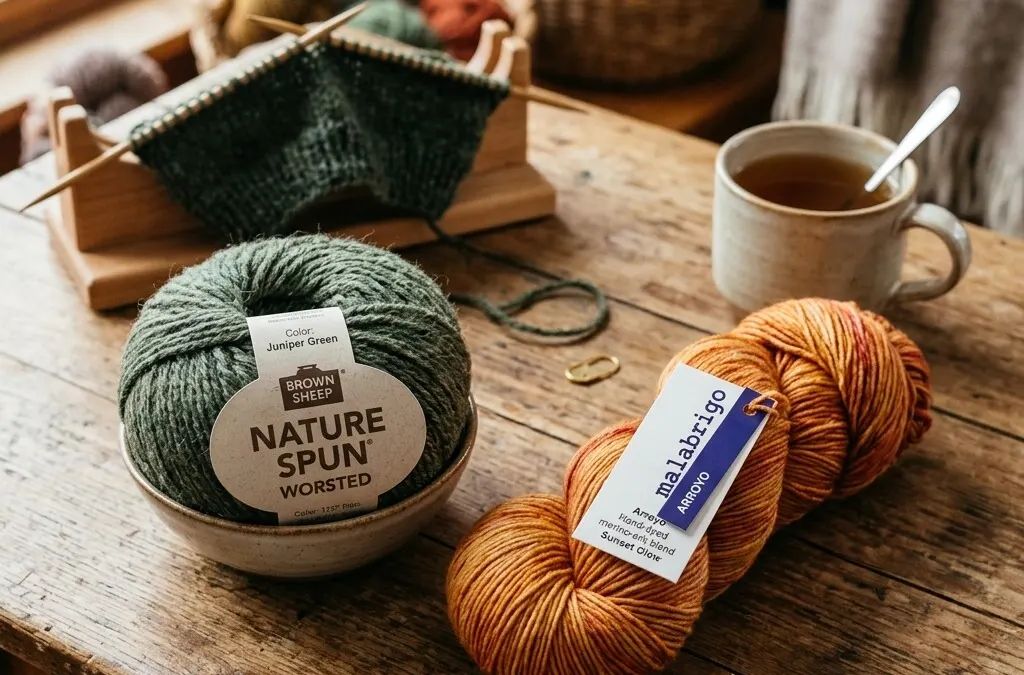
To substitute yarn in a pattern, you must find a yarn with a similar yardage, calculate how many skeins you need, and knit a swatch to verify your gauge. Yardage is more important than weight!
A Norwegian version of this page is available on Strikketips.no
Why would you substitute yarn?
There are many good reasons to substitute yarn in a pattern. Maybe you can't get hold of the original yarn, or you have found a yarn on sale that you want to use. Some have allergies to wool and need to find alternatives, while others want a different color or quality than what the pattern suggests.
To succeed with a yarn substitution, you must understand a few basic concepts: yardage, gauge, and yarn weight. If you have control over these three, you can substitute to almost any yarn with confidence. Remember that you can also use our yarn substitution calculator to do the exact calculations.
Step 1: Understand yardage
Yardage is the most important concept when you substitute yarn. It tells you how many meters or yards of yarn you get in a skein or per 3.5 oz100 g. You can find this on the yarn label.
- Fingering / sock: around 400 m (437 yd) per 100 g — for example Cascade Heritage, WYS Signature 4 Ply
- Worsted / aran: around 200 m (220 yd) per 100 g — for example Cascade 220, Malabrigo Worsted
- Bulky / super bulky: around 100 m (110 yd) per 100 g — for example Cascade 220 Grande, Lion Brand Wool-Ease Thick & Quick
Two yarns can weigh the same but have completely different yardage. A thin yarn has a longer yardage than a thick yarn at the same weight. Therefore, it is the yardage - not the weight - that determines how much yarn you need.
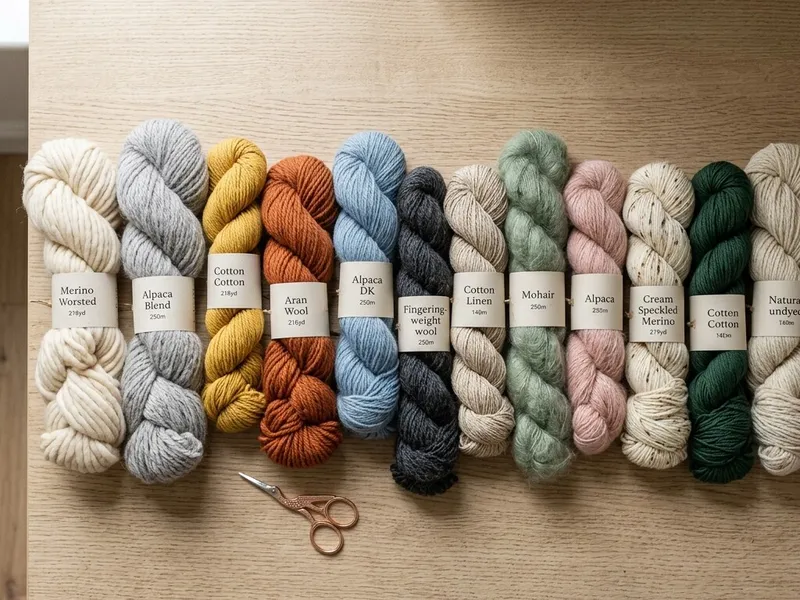
Step 2: Calculate how much yarn you need
Once you have found an alternative yarn with a similar yardage, you must calculate how many skeins you need. Here is the formula:
Number of new skeins = (Original yardage × Original number of skeins) ÷ New yarn yardage
The pattern requires 5 skeins of 50g with 175 meters per skein. You want to use a yarn with 200 meters per skein.
Total yardage: 5 × 175m = 875m
New skeins: 875m ÷ 200m = 4.375 ≈ 5 skeins
Tip: Always round up! It is better to have slightly too much yarn than too little.
Want to avoid the math? Use our yarn substitution calculator which does the job for you in seconds.
Step 3: Check yarn thickness and fiber content
Even if the yardage is similar, you should also consider yarn thickness and fiber content. This affects how the finished garment looks and behaves.
Yarn Weight Categories
Yarn is standardized into Craft Yarn Council weight categories (CYC 0–7): Lace (0), Fingering (1), Sport (2), DK (3), Worsted (4), Aran (CYC 4), Bulky (5), and Super Bulky (6–7). Explore our full Standard Yarn Weights Guide & Chart for complete gauge ranges, wraps per inch (WPI), and recommended needle sizes. For the best substitution results, choose yarn from the exact same weight category.
Fiber Content
Different fibers behave differently:
- Wool: Elastic, warm, forgives minor gauge deviations
- Cotton: Less elastic, can stretch/sag, great for warm weather
- Alpaca: Very warm, can be heavy, minimal elasticity
- Acrylic: Inexpensive, machine-washable, less breathable
- Blends: Combines properties from multiple fibers
If you substitute wool with cotton or vice versa, the garment may behave differently than expected. Cotton stretches more in length, while wool is more elastic.
Step 4: Knit a swatch
This is the most important step - and the one many people skip! Even if you use yarn with the same yardage, your personal gauge can vary with different yarn types.
How to make a swatch:
- Knit a swatch of approx. 6 x 6 inches (15 x 15 cm) in the stitch pattern specified in the pattern.
- Wash and dry the swatch the way you plan to care for the garment.
- Measure how many stitches you have per 4 in10 cm, and compare with the gauge specified in the pattern.
- Switch to larger needles (adjust up) if you have too many stitches (you are knitting tighter than the pattern), or smaller needles (adjust down) if you have too few stitches (you are knitting looser).
Frequently asked questions
Can I always substitute yarn in a pattern?
Yes, you can substitute yarn in most patterns, but you must ensure the new yarn has similar yardage and gauge as the original. Some patterns are more sensitive to yarn substitution than others - especially those with complex patterns or specific drape requirements.
What is most important when substituting yarn - weight or yardage?
Yardage is the most important! Two yarns can weigh the same but have completely different yardage. Always use yardage (meters/yards per skein or per 100g) as the basis for your calculation, not weight.
How do I know if the yarn is suitable for the pattern?
Check three things: 1) Yardage should be similar, 2) Gauge must match (knit a swatch!), 3) Yarn weight category and fiber content should be similar for the best result.
Do I have to knit a swatch when substituting yarn?
Yes, absolutely! Even if you use yarn with the same yardage, different yarn types can result in different gauge. A swatch ensures that the finished garment will be the correct size.
Can I substitute wool with cotton?
Yes, but be aware that cotton and wool behave very differently. Cotton has less elasticity and can become heavier when washed. Cotton garments can also 'sag' more than wool. Consider if this is appropriate for your project.
Weight categories and their standard gauge ranges follow the Craft Yarn Council's Standard Yarn Weight System. Yardage and fiber content for specific yarns are taken from each manufacturer's own product pages rather than from retailer listings.