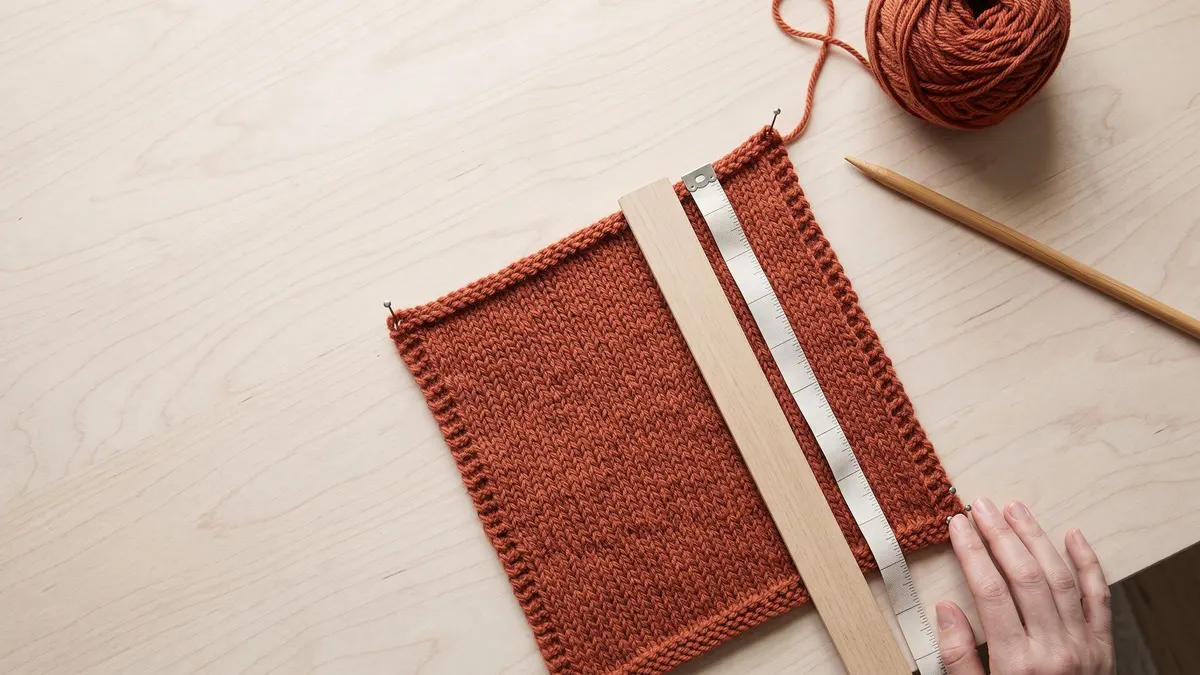
Knitting gauge is the number of stitches and rows you get over a certain measurement – usually over a 4 x 4 in (10 x 10 cm) square. It tells you how tightly or loosely you knit. Check your gauge with our gauge calculator.
A pattern states its gauge as two numbers — for example 20 sts and 28 rows = 4 in10 cm — and the stitch counts in the pattern are built on them. Match them and the pattern's measurements are the ones you'll get. Miss them and the stitch counts produce a different size from the one the pattern promises.
A Norwegian version of this page is available on Strikketips.no
Why one stitch changes the garment
Too many stitches per 4 in10 cm means you knit more tightly than the pattern, and the garment comes out smaller. Too few stitches means you knit more loosely, and it comes out larger.
The difference sounds small until you multiply it. A sweater body worked over 220 stitches at 22 sts per 4 in10 cm measures 40 in100 cm around. Knit the same 220 stitches at 21 sts — one stitch looser — and you get about 42 in105 cm. The more stitches a piece has, the further the same small difference carries: small pieces forgive a stitch, sweaters don't.
Using the pattern's yarn and needle size does not guarantee the pattern's gauge. Your hands are the third ingredient, and they are the one the pattern can't specify. That is what the swatch is for.
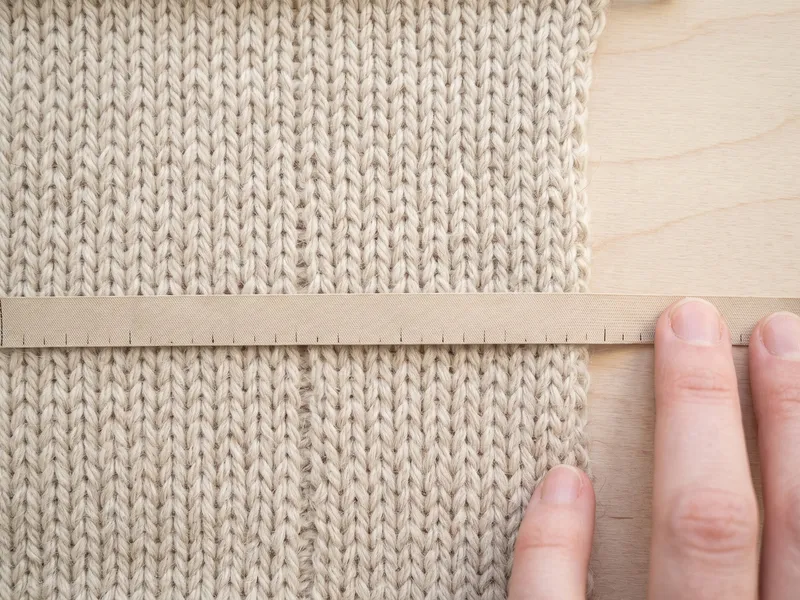
Checking gauge: the short version
-
Knit a swatch bigger than you think
Wide and tall enough to measure 4 in10 cm in the middle, well away from the edges.
-
Wash and dry it
The way you'll wash the finished garment. Then let it dry completely.
-
Measure it flat
On a table, without stretching it. Count stitches across and rows up, half stitches included.
-
Compare, and change needles if needed
Too many stitches: go up a needle size. Too few: go down. Then swatch again.
Each step has a way of going wrong. The full method — how big, where to measure, and what different fibers do in the wash — is in how to knit a gauge swatch. When the numbers still don't match, gauge errors goes through the usual causes one at a time.
Superwash-treated yarn can grow noticeably when wet. Don't measure a superwash swatch until it has been washed and is completely dry. A garment built on the unwashed number can come out of its first wash too big.
Compare your gauge with the pattern
Enter the pattern's gauge and yours to see which way to change needles and how wide the garment would come out if you carried on.
Could not save. Your browser may be full or in private mode — write down anything you need, because it will be gone when you reload the page.
Result: Knitting Gauge
Gauge Calculator
Compare your actual knitting gauge with the pattern requirements. Get exact needle size recommendations and custom stitch counts to achieve the perfect fit.
When you can't match the pattern's gauge
Sometimes no needle gives you both the right number and a fabric you like. Then you can keep your own gauge and recalculate the pattern instead. It's arithmetic, not guesswork:
new stitch count = pattern's stitch count × your gauge ÷ pattern's gauge
Say the pattern expects 20 sts per 4 in10 cm and casts on 200 stitches — that is 40 in100 cm. You get 22 sts. Then 200 × 22 ÷ 20 = 220 stitches, which at your gauge is again 40 in100 cm. You knit more stitches per inch, so you need more of them to cover the same width.
Lengths work the same way with row gauge, or you can avoid row arithmetic entirely by knitting to the measurement the pattern gives rather than to its row count. Row gauge covers when that works and when it doesn't.
Recalculating is easiest on simple constructions. Afterwards, check that the new number still works with any stitch-pattern repeat — if the pattern needs a multiple of 4, round to one.
Go deeper
- How to knit a gauge swatch — size, measuring, blocking, and what fibers do in the wash.
- Stitch gauge vs. row gauge — what row gauge controls, and what to do when only that one is off.
- Gauge in the round vs. flat — why the two differ, and how to swatch for a circular project.
- Gauge errors — diagnosing a swatch or a garment that came out the wrong size.
- Gauge calculator — the formulas, stitch counts, and converting between per 4 in and per 10 cm.
- Yarn weights — the gauge range each yarn weight category is designed for.
Frequently Asked Questions
What does "20 sts and 28 rows = 4 in10 cm" mean?
It means the designer's fabric had 20 stitches across and 28 rows up in a square of 4 in10 cm. The first number decides how wide your garment comes out; the second decides where shaping lands vertically.
What do I do if I get too many stitches per 4 in10 cm?
Too many stitches means you are knitting more tightly than the pattern. Go up a needle size and knit a new swatch.
What do I do if I get too few stitches per 4 in10 cm?
Too few stitches means you are knitting more loosely than the pattern. Go down a needle size and knit a new swatch.
Can I measure gauge while the work is still on the needles?
It's better to bind off, wash and dry the swatch first. Stitches can change a lot in the first wash, especially in superwash yarn, and an unwashed measurement tells you about fabric your garment will not end up as.
How do I adjust a pattern if I can't match the gauge?
Divide your own stitch gauge by the pattern's, then multiply the result by the number of stitches the pattern tells you to cast on. At 22 sts where the pattern expects 20, a 200-stitch cast-on becomes 200 × 22 ÷ 20 = 220 stitches. Then check that the new number still fits any stitch-pattern repeats.
Gauge is measured over 4 in10 cm and yarn weight categories are named according to the Craft Yarn Council's Standard Yarn Weight System, the convention used by US pattern publishers.