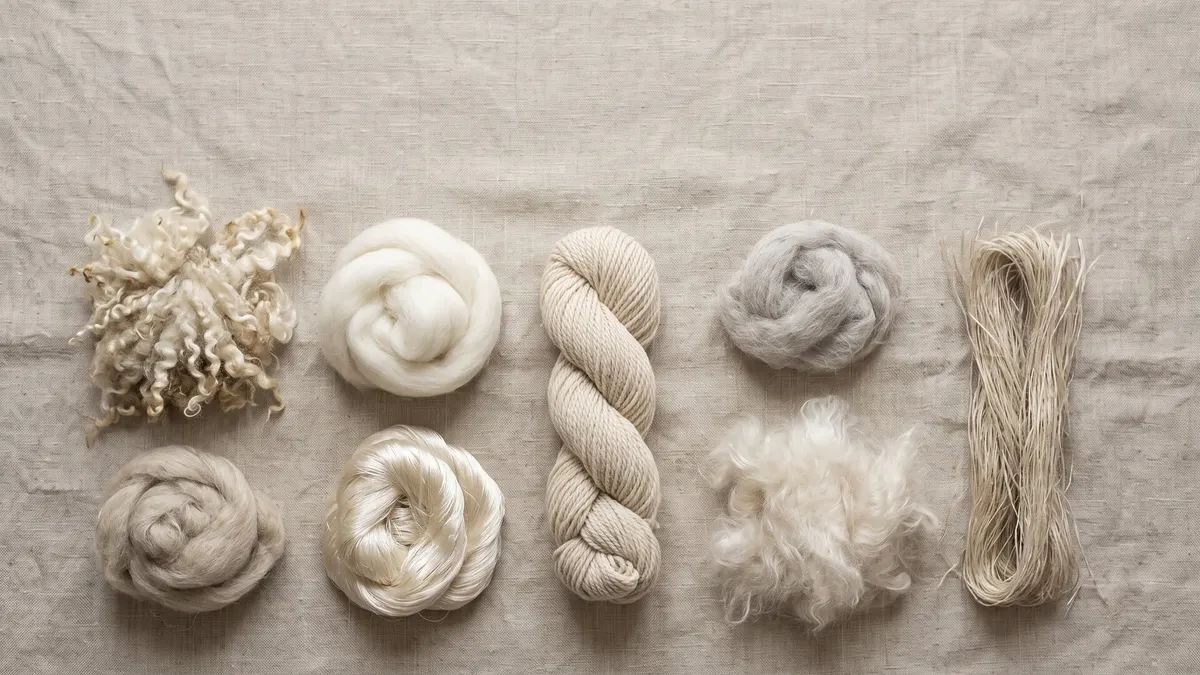
Choosing the right yarn is half the job. Here is an overview of the most common fiber types and what they are best suited for.
Quick answer: Fiber content determines
how warm, heavy, elastic, and durable your finished
garment will be – often more than the color or the
pattern itself. Use the lexicon below to find the
fiber that fits your project, and read on for tips on
natural vs. synthetic fiber, blends, and yarn care.
A Norwegian version of this page is available on Strikketips.no
How to choose the right fiber for your project
When picking yarn for a new project, it's easy to stop at
color and price. But fiber content matters just as much,
because it determines how the finished piece behaves –
both while you knit it and for years afterward. A sweater
knit in alpaca will stretch and sag over time, while the
same pattern knit in wool holds its shape far better.
Ask yourself a few questions before you decide: Will the
garment sit against the skin, or is it outerwear? Does
the pattern rely on elasticity – cables or ribbed edges
that need to stay snug? Does it need to survive the
washing machine, or is hand washing fine? Do you or the
recipient have a wool allergy? The answers will quickly
point you toward the right fiber family.
Next to the skin (base layers, baby clothes): choose
soft fibers without prickly hairs, like Merino wool or
cotton.
Outerwear and winter garments: choose
warm fibers with good elasticity, like wool or
wool/alpaca blends.
Summer garments: choose cooling,
breathable fibers like linen or cotton.
Patterns with cables or ribbing: choose
elastic fibers – ideally with a high wool content – so
the stitch structure holds its shape.
Natural fiber vs. synthetic fiber
Yarn is generally grouped into four origins: animal-based
(from animals, like wool and silk), plant-based (from
plants, like cotton and linen), regenerated (plant pulp
chemically dissolved and spun anew, like viscose made from
bamboo), and synthetic (made from petroleum products, like
acrylic, polyester, and nylon/polyamide). Regenerated fibers
are easily filed in the wrong drawer: the raw material is a
plant, but the fiber is made in a factory. Natural fibers
breathe, regulate temperature, and often feel more luxurious
against the skin, but they typically cost more and need
gentler washing.
Synthetic fibers are cheaper, highly durable, and
usually machine-washable without shrinking. They are also
an option for knitters who cannot wear wool next to the
skin — we do not call them allergy-friendly, since that
is a health claim we have no basis for. The downside is
that they breathe less well, can feel "sticky" against
the skin on warm days, and do not break down the way
plant and animal fibers do. In practice, acrylic and nylon are rarely
used alone for an entire garment, but they often show up
in blends to add durability – especially in sock yarn.
Blend yarns: the best of multiple fibers
Many of the most popular yarns are blends, because
blending lets you combine the strengths of two or more
fibers. A classic example is sock yarn, which is often
around 75–80% wool and 20–25% nylon. The wool provides
warmth and comfort, while the nylon lets the heel and toe
withstand the friction from shoes without wearing
through.
Silk is often blended with mohair to tame its airy "halo"
and add shine and strength, while wool and alpaca are
combined to get alpaca's soft warmth without the garment
losing all its elasticity. Always read the fiber content
on the yarn label – the percentages tell you a lot about
how the yarn will behave, even when the yarn's name
doesn't spell out every fiber.
Fiber types from A to Z
Animal-based
Wool (Sheep)
Sheep wool is the fiber most knitting yarns are built on — 28 of the 31 yarns in our own Norwegian brand guide contain wool or merino. It is naturally temperature-regulating, breathable, and can absorb significant moisture without feeling wet.
Properties
Warm · Temperature regulating · Elastic · Odor resistant
Best for
Sweaters · Outerwear · Winter clothes
Yarn examples
West Yorkshire Spinners Signature 4 Ply · Cascade Yarns 220 Sport · Lion Brand Wool-Ease DK
Animal-based
Merino Wool
Extra fine wool from Merino sheep. The fibers are thinner and crimpier than regular wool, making it extremely soft and non-itchy against the skin.
Alpaca fiber is essentially free of lanolin (wool grease), which is why many people find it gentler against the skin than sheep wool. It is extremely soft, but lacks elasticity and stretches out of shape more easily than wool.
Fiber from Angora goats. Known for its silk-like luster and "halo" (fuzzy surface), and the fibers are stronger than wool fibers. In knitting yarn it usually appears blended with silk or wool.
Rowan Kidsilk Haze · Brown Sheep Lamb's Pride Worsted
Animal-based
Cashmere
The undercoat of the cashmere goat, gathered by combing or shearing in spring when the goat sheds. The fiber is very fine and gives warmth out of all proportion to its weight. It has little elasticity, so pure cashmere loses its shape more easily than wool and should be stored flat.
Properties
Extremely soft · Very warm · Lightweight · Low elasticity
Best for
Cowls · Luxury sweaters · Scarves
Animal-based
Angora (Rabbit)
Fiber from the Angora rabbit — not to be confused with mohair, which comes from the Angora goat. The fiber is very soft, fine, warm and light, with a pronounced halo. Lower-grade angora sheds, and the fiber is often blended with wool.
The undercoat of the yak, a domestic animal of the Tibetan highlands and the ranges around them. The animal is an even brown with a silver-grey stripe along the back, and many yarns keep that natural colour undyed. In our experience yak yarn feels soft without losing its shape as readily as pure cashmere.
Properties
Soft · Warm · Naturally coloured
Best for
Sweaters · Scarves · Undyed garments
Plant-based
Cotton
Plant-based fiber that is durable, breathable, and absorbent. It has no natural elasticity, making the garment firm and durable.
Properties
Cooling · Durable · Absorbent · Heavy
Best for
Summer clothes · Washcloths · Interior decor
Plant-based
Linen
Made from the stalks of the flax plant. Linen has probably been in use for more than 10,000 years. The fiber has higher tensile strength than cotton, absorbs more moisture and dries faster — which is why it feels cooler. In our experience it softens with use and washing.
Properties
Very cooling · Very durable · Inelastic · Glossy
Best for
Summer tops · Tablecloths · Curtains
Animal-based
Silk
Produced from the cocoon of the silkworm. The fiber is counted among the most exclusive textile fibers, both for its luster and its strength. It absorbs up to a third of its own weight in moisture without feeling wet, and can feel cool against the skin.
Properties
Strong · Lustrous · Temperature regulating · Luxurious
Best for
Tops · Shawls · Blended yarns
Yarn examples
Rowan Kidsilk Haze
Regenerated
Viscose Made from Bamboo
Viscose chemically regenerated from bamboo pulp — a manufactured fiber, not a natural one, despite what the name suggests. It has a fantastic drape, is silky soft, cooling and moisture-absorbent. US labeling rules require it be called viscose or rayon made from bamboo, not simply bamboo.
Properties
Beautiful drape · Super soft · Cooling · Absorbent
Best for
Summer tops · Baby garments · Drapey garments
Synthetic
Polyamide (Nylon)
A synthetic fiber that is extremely durable and elastic. Almost always blended with wool (especially in sock yarn) to add strength.
Rarely used alone in knitting yarn, but often appears as a small share in blends — as an effect thread, as the load-bearing core of thick yarns, or as filling in tape yarns. It is hard-wearing and holds its shape, but does not move moisture away from the skin the way wool does.
Properties
Hard-wearing · Holds its shape · Affordable · Poor breathability
Even though each fiber has its own care recommendations
(see the cards above), a few general rules apply to all
hand-knitted items. Always check the ball band before
washing – it states the exact temperature and washing
method the manufacturer recommends, and the details can
vary even within the same fiber type depending on how it
was processed.
Use a wool wash without fabric softener for
animal fibers – softener can break down the natural
structure of wool and silk over time.
Dry garments flat. Hanging stretches
most yarn types, especially cotton and alpaca, which
have little elasticity to begin with.
Store wool against moths in
breathable cotton bags, ideally with lavender or
cedar, and never in sealed plastic for long periods.
Block finished garments gently – wet
blocking evens out your gauge and helps natural
fibers "set" into the correct shape.
Superwash-treated yarn (commonly seen with Merino wool)
is the exception to the hand-wash rule: it usually
withstands machine washing on a wool cycle because the
fiber surface has been treated to prevent felting. Keep
in mind that the treatment can make the yarn slightly
slicker to knit with and reduce its natural elasticity
somewhat.
Frequently Asked Questions About Fibers
Why does wool itch?
Wool can itch depending on the fiber's micron count (thickness). Thicker fibers itch more because they poke the skin, while fine fibers like Merino wool bend and feel soft. Some people are also sensitive to lanolin, the natural fat in wool.
What is Superwash yarn?
Superwash is wool that has been chemically treated or coated with a thin polymer to prevent the fibers from felting. This allows the yarn to be machine-washed without shrinking, but it loses some of its natural breathability and odor resistance.
Can I substitute wool with cotton?
It is possible, but remember that cotton and wool behave very differently. Cotton lacks elasticity, so a cotton garment will easily sag and lose its shape if the pattern was designed for wool. Cotton also breathes differently and doesn't warm when wet.
What is a blend yarn and why is it used?
Blend yarns combine multiple fiber types to utilize the best of both worlds. For example, a blend of wool and nylon provides a yarn that is warm but also highly durable (perfect for socks). Silk and mohair are often blended to provide luster and strength to the fuzzy mohair.
Micron ranges and fiber classifications follow
The Woolmark Company
for wool, and
Textile Exchange
for fiber production and certification. Fineness is a range, not a fixed number:
the same breed varies by flock and by which part of the fleece the fiber came from.
We use cookies for analytics and advertising. Nothing is loaded until you choose. Read more in our privacy policy.