Guide
Washing and Care Guide
Wool tolerates being washed rarely. Here you'll learn how to wash as little as possible, but correctly when you must.
A Norwegian version of this page is available on Strikketips.no
Wool rarely needs washing, so the best wash is usually the one you skip. But once a garment does go into the water, only a few things separate knitwear that lasts twenty years from knitwear that felts in one afternoon: temperature, detergent and how hard you handle it.
Airing is Washing
Wool draws moisture into the fiber itself rather than leaving it against your skin, which denies bacteria the damp surface they need. Often, just hanging the garment out to air overnight is enough.
Avoid Temperature Shock
It's not warm water that shrinks wool, but the combination of temperature changes and agitation.
How to Wash Hand-Knits
If you're in a hurry, this is the whole guide in three points. The detail follows right after.
- 01
Choose Your Method
If the garment is labeled "Superwash," you can use the machine's wool program. For hand washing: Use lukewarm water (about 86°F30°C) and plenty of wool detergent.
- 02
Wash Gently
Gently move the garment in the water. Do not rub or scrub, as this can lead to felting. Rinse in several stages with water that has the same temperature as the wash water.
- 03
Drying
Carefully lift the garment out of the water. Do not let it hang and drip, as the weight of the water will stretch the fibers. Roll it in a dry towel and step on it to remove excess water. Always dry flat.
Hand Washing, Step by Step
Hand washing sounds fussy and isn't. It takes about ten minutes of actual work plus a soak, and it is gentler on a hand-knitted garment than any machine cycle. The whole method rests on one principle: wool felts when friction, water and a change in temperature happen at the same time. Remove any one of those three and your knitting is safe. That is why we soak instead of scrub, and why the rinse water has to be the same temperature as the wash water.
- 01
Prepare the Garment
Shake out loose dust, do up any buttons so the band doesn't stretch, and turn the garment inside out. If there is a stain, deal with it now: dab it gently with a little wool wash on your fingertip. Don't rub at it — rubbing a wet spot is the fastest way to felt one small patch of an otherwise perfectly good sweater.
- 02
Fill the Basin with Lukewarm Water
Use a clean basin, a sink or a bathtub, and fill it with lukewarm water — it should feel neither warm nor cold against the inside of your wrist, roughly body temperature. It is not warmth on its own that shrinks wool; it is the change in temperature combined with movement. So the exact number matters far less than keeping it the same from the first soak to the last rinse.
- 03
Add Wool Wash
Stir a small amount of pH-neutral wool wash into the water before the garment goes in, so undiluted detergent never sits directly against the fibers. A capful is usually plenty; more soap only means more rinsing. Never use ordinary laundry detergent, which contains enzymes that break down the protein in wool, and never use fabric softener, which coats the fibers and ruins their breathability.
- 04
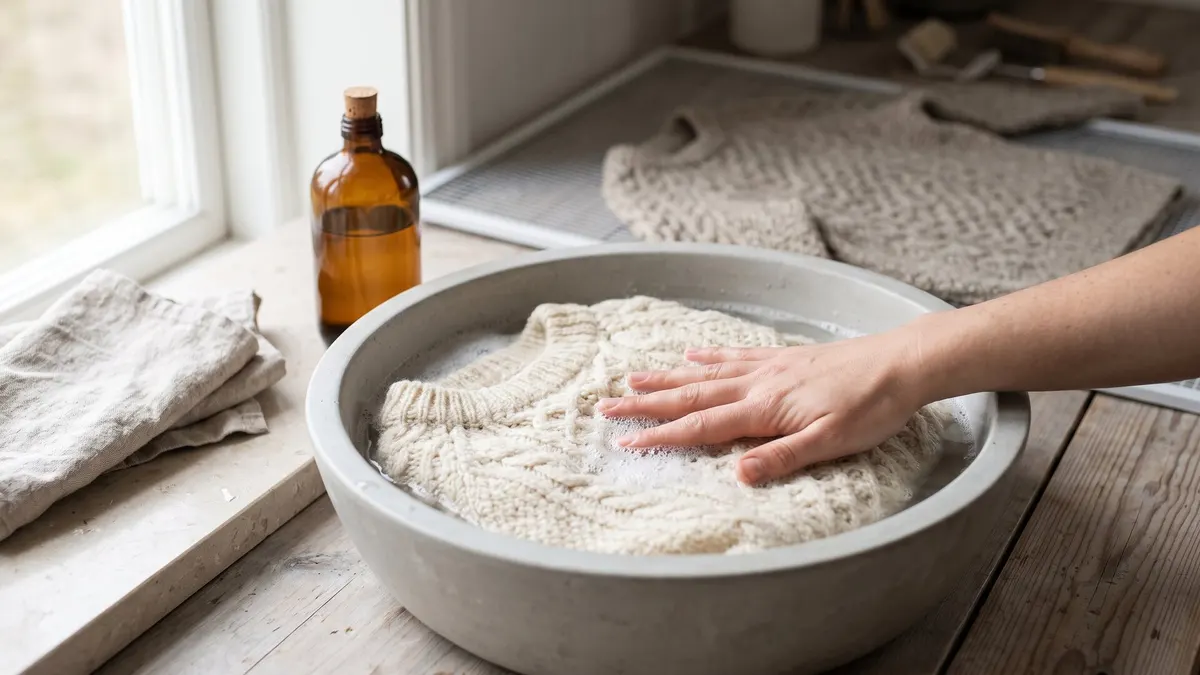
Let It Soak
Lower the garment in and press it gently under the surface until it is completely saturated — dry wool floats, and it can take a minute. Then leave it alone for fifteen to twenty minutes. The soaking is what does the cleaning; there is nothing to be gained from swirling it around, and quite a lot to be lost.
- 05
Never Rub, Wring or Twist
This is the rule that matters most. Don't rub the fabric against itself, don't scrub at cuffs, and never wring the garment out the way you would a dishcloth. If a stubborn spot needs more attention, support it with a flat hand and squeeze gently instead. Wringing does two kinds of damage at once: it felts the fibers and it permanently distorts the stitches.
- 06
Rinse at the Same Temperature
Drain the basin, lifting the garment aside rather than letting it sit in the outflow, and refill with water at the same temperature as before. Press the garment gently under the surface, let it sit a moment and drain again. Repeat until the water runs clear — usually twice is enough. Many wool washes are designed to be left in, in which case you can skip this step entirely; check the bottle.
- 07
Press the Water Out in a Towel
Gather the garment together in the water and lift it out supported from underneath with both hands. Never let it hang: a wet sweater can hold well over its own weight in water, and that weight will pull the fabric out of shape in seconds. Press it against the side of the basin to shed the worst, then lay it flat on a dry towel, roll the towel up with the garment inside like a Swiss roll, and press down firmly along the roll — kneel on it if you like. Use a second dry towel if the first comes out soaked.
- 08
Dry Flat and Ease It Back into Shape
Unroll the towel and move the garment onto a fresh dry one, or onto a drying rack that lets air circulate underneath. Now, while it is still damp, gently ease it back to its intended measurements: square up the shoulders, straighten the side seams, pat the ribbing back in. Keep it out of direct sunlight and away from radiators, both of which dry the outside long before the inside. Turn it over once it is about half dry, and don't wear it or fold it away until it is dry all the way through.
Pilling and Shedding
Every knitted garment pills with use, especially where there is friction: under the arms, along the sides and wherever a bag strap rests on the shoulder. Pills are not a sign of bad yarn but of short fibers working their way out of the ply, and most garments settle down after a couple of rounds of de-pilling.
Storage
Knitted garments should never hang on a hanger: the weight of the garment drags the shoulders out of shape, and a beautiful yoke never quite recovers. Fold them neatly and store them in a drawer or on a shelf, heaviest at the bottom.
Frequently Asked Questions
How often should I wash my wool sweater?
As rarely as possible! Wool resists odor well because the fiber binds moisture inside itself instead of leaving it on the surface where bacteria thrive. Hang the garment out to air to freshen it up, and wash only when it has stains or actually smells of sweat.
Can I use fabric softener on wool?
No, you should never use fabric softener on wool or other knitted garments. Fabric softener leaves a coating on the fibers that destroys wool's natural breathability, and it can cause the garment to lose its shape.
Help, my wool sweater has shrunk! Can it be saved?
Maybe! Soak the sweater in lukewarm water with a generous amount of hair conditioner for about 30 minutes. The conditioner helps the wool fibers relax. While it's in the water, you can very gently stretch it. Don't rinse out the conditioner, but gently press the water out in a towel, and carefully block it back into shape before drying flat.
The neutral-detergent rule and flat drying follow The Woolmark Company’s wool care guidance, and wool’s odor resistance is described in their research on odor-resistant wool. Woolmark gives the machine wool cycle as “usually gentle action at 40°C”; the 30°C we suggest for hand washing is our own, more cautious advice, not a figure from them. The symbols on your ball band are the international care labelling symbols standardised as ISO 3758 and administered by GINETEX.