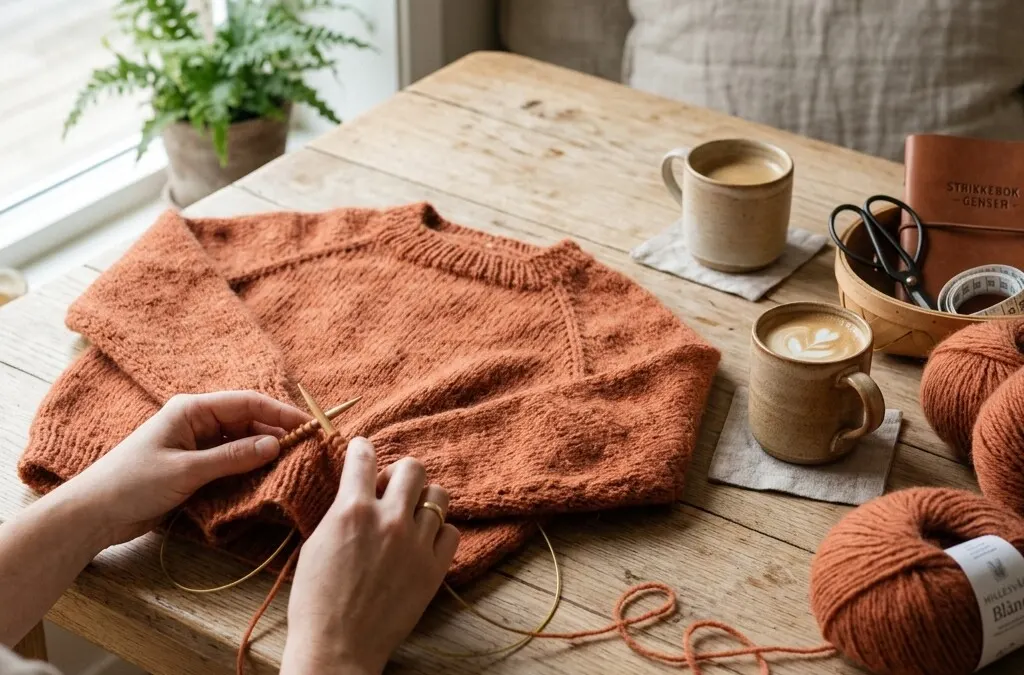
Knitting a sweater is perhaps the goal most knitters set for themselves. Wearing a garment you created with your own hands is an amazing feeling. Here is the overview you need to succeed with your first knitted sweater: which construction to pick, which yarn suits it, and how to land on the right size.
A Norwegian version of this page is available on Strikketips.no
A sweater is a bigger project than a hat or a scarf, but it is not the techniques that make it demanding — if you can knit and purl, cast on and bind off, you already have everything you need. What decides whether the result is a garment you actually wear is the preparation: your gauge, your yarn choice, and your size.
Checklist before you cast on
Work through these five points before you cast on the first stitch. They cost you an evening — discovering a problem after a hundred hours of knitting costs you the whole sweater.
-
Gauge swatch
Have you knitted, washed and measured your swatch? Two stitches off per 4 inches can leave the sweater four inches too big or too small across the chest. Read more in our gauge guide.
-
Yarn and dye lot
Do you have enough yarn for the whole garment, and do all the balls share the same dye lot? Shades vary between lots, and the shift is clearly visible halfway up a body.
-
Needles
Do you have both the main needle and the smaller ribbing needle? Check that the circular is long enough for the body, and that you have DPNs or a long enough needle for Magic Loop on the sleeves.
-
Notions
Stitch markers, a tapestry needle for weaving in ends, a measuring tape, and a stitch holder or waste yarn for the sleeve stitches while you finish the body.
-
Read the whole pattern
Read the pattern from start to finish once before you begin, so you understand the construction and spot any techniques you need to practise first.
Which construction? Raglan, yoke, or set-in sleeves?
Sweater patterns vary greatly based on how the garment is constructed:
The four primary sweater construction methods offer distinct shoulder lines, sleeve fits, and knitting workflows.
- Raglan: Sleeves and body are joined on a long circular needle. The decreases run diagonally from under the arms towards the neckline. This is often easiest for beginners because it requires minimal seaming.
- Round yoke: Like raglan, everything is knitted in the round and joined. Instead of diagonal lines, decreases occur evenly in a circle around the entire yoke (shoulders/chest). Often found in Icelandic sweaters (lopapeysa)!
- Set-in / drop shoulder: The body and sleeves are knitted separately, either flat or in the round (steeking). Seaming is required. Usually not the most beginner-friendly choice.
We highly recommend choosing a sweater knitted top-down! It lets you try the sweater on as you go, check whether the sleeves are long enough, and adjust the body length without ripping back the whole garment at the end.
What yarn is best for a sweater?
One of the most common questions we get is "What yarn is best for a sweater?". The answer depends entirely on who will wear it and what time of year it will be used:
- Non-superwash wool: Warm, breathable and water-resistant. Excellent for classic outdoor sweaters. Easy to knit with and hides uneven tension well.
- Merino wool: Very soft, totally itch-free, and great for lighter everyday sweaters. Superwash-treated merino tends to grow, so wash your gauge swatch!
- Alpaca: Warmer than sheep's wool and drapes beautifully. Less elastic, which makes ribbing a bit looser.
- Cotton: Perfect for summer sweaters or those sensitive to wool, but heavier and lacking elasticity.
If you want to substitute the yarn the pattern recommends, compare the yardage — not the name of the yarn weight. Our yarn substitution calculator works out how many balls of the new yarn you need.
Many merino yarns are superwash-treated. While this makes them machine washable, they tend to sag and grow when wet. Always wash your gauge swatch to see how the yarn behaves, or your sweater might end up several sizes too large after its first wash!
Measurements and sizing
Should the sweater be tight-fitting (negative ease) or have a relaxed fit (positive ease)? The pattern usually lists the finished chest circumference. Measure across the widest part of your chest, then add — or subtract — the ease the pattern recommends.
If you fall between two sizes, look at the shoulder measurement rather than the chest. Body width can be adjusted with ease, but a shoulder that sits wrong is hard to rescue afterwards.
Conclusion
A first sweater is less about technique than about preparation. Pick a pattern knitted top-down, knit and wash your swatch, and spend a few minutes on measurements before you cast on. The rest is just calm rounds — and a garment you will actually wear.
Frequently Asked Questions (FAQ)
What yarn is best for a sweater?
The best yarn for a sweater depends on its use. Wool is warm and breathable, perfect for winter. Cotton is cool for summer wear, while alpaca adds an exclusive and soft touch. For beginners, a smooth multi-ply wool yarn is often recommended as it's easy to knit evenly with.
How long does it take to knit a sweater?
This varies wildly based on yarn weight, needle size, and how much time you spend each day. A chunky sweater on 6–8 mm (US 10–11) needles might take a couple of weeks, while one on fingering weight yarn can take months.
Is it difficult to knit a sweater?
No! If you can knit and purl, cast on and bind off, you can knit a sweater. There are many patterns specifically designed for absolute beginners.