To start a knitting project, you need to cast on stitches onto your needle. There are many ways to do this. We start with the Long-Tail Cast-On: it gives an elastic, neat and sturdy edge that works for most projects.
Step-by-Step: The Long-Tail Cast-On
Slip knot
Make a slip knot and place it on the needle. It counts as your first stitch.
Make the V
Hold both strands in your left hand — tail over the thumb, working yarn over the index finger.
Scoop and catch
Bring the needle up under the thumb strand, then over and behind the finger strand.
Draw through
Pull that strand back down through the thumb loop, slip your thumb out, and tighten gently.
The long-tail cast-on looks fiddly written down; it gets easier after the first few stitches.
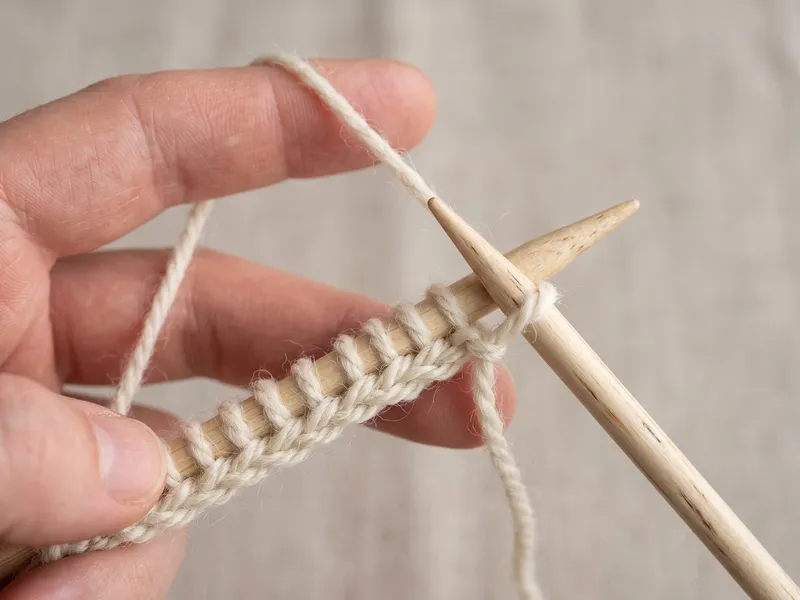
Before you begin, make sure you leave a long enough tail. A good rule of thumb is about three times the width you are casting on, plus an extra 6–8 inches15–20 cm for weaving in. If you're unsure, cast on ten stitches, see how much tail they used, and multiply.
Step 1: The Slip Knot
Make a slip knot and place it on the needle. This counts as your first cast-on stitch. Hold the needle in your right hand.
Step 2: The Slingshot Position
Position the yarn in your left hand. The tail end should go over your thumb, and the ball end should go over your index finger. Secure both strands in your palm with your remaining three fingers. It should look like a slingshot.
Step 3: Go Under the Thumb Loop
Bring the needle tip down, then insert it up through the loop on your thumb from the bottom.
Step 4: Grab the Yarn
Reach the needle tip over to the index finger, grab the yarn strand going over it from the top, and pull it down through the loop on your thumb.
Step 5: Tighten the Stitch
Drop the loop off your thumb. Use your thumb to catch the tail strand again, and pull your thumb and index finger apart to snug the stitch onto the needle. Do not pull it too tight!
How to Avoid a Tight Cast-On Edge
A common issue for beginners is a tight cast-on edge that makes the cuff of a sleeve or sock impossible to stretch, or causes the edge to roll. To prevent this, try these simple tips:
- Cast on holding two needles: Hold two needles together as if they were one, cast on, then slip one needle out before starting to knit.
- Use a larger needle size: Cast on using a needle one or two sizes larger than the one required for the project, then switch to the correct size for the first row.
- Leave space between stitches: Leave a small gap between the stitches on the needle as you cast them on, rather than squeezing them tightly together.
See how it's done
Sometimes it's easier to see the technique in action. Here is a clear step-by-step video showing how to do the Long-Tail Cast-On:
Video from VeryPink Knits
Frequently Asked Questions
How much tail do I need for the long tail?
About three times the width you are casting on, plus an extra 6–8 in15–20 cm for weaving in afterward. For 100 stitches on a US 6 (4 mm) needle the width is around 18 in46 cm, so about 60 in150 cm of tail. Not sure? Cast on ten stitches, see how much tail they used, and multiply.
Why does my cast-on edge come out too tight?
Try casting on over two needles held together, going up a needle size just for the cast-on row, or leaving a small gap between stitches as you cast them on.
Are there other ways to cast on stitches?
Yes, there are many methods, like the Italian cast-on (for an extra stretchy edge) or a provisional cast-on (for stitches you'll work later). We teach the long-tail method first because it works for most projects.
Does the slip knot count as a stitch?
Yes, the slip knot you start with counts as your very first stitch on the needle.