Trender
Knitting Trends 2026: What Actually Changed
Trend writing in this craft is mostly guesswork dressed up as reporting. This is our attempt to separate the parts that are actually documented from the parts that are marketing.
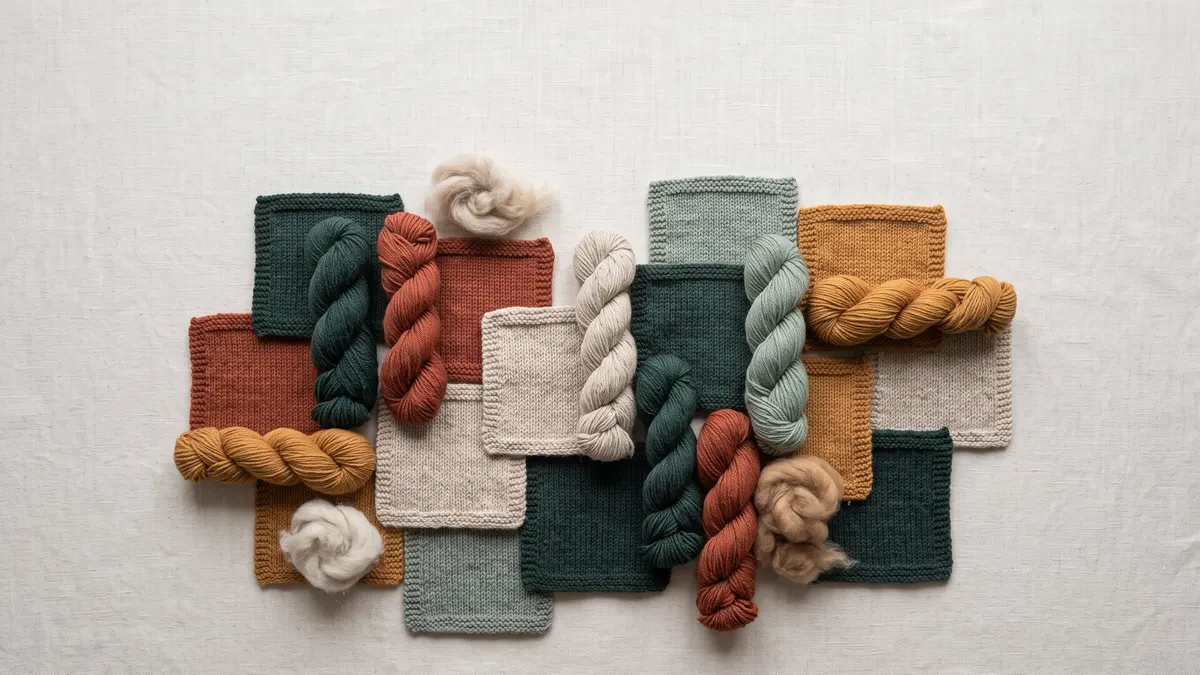
Most knitting trend pieces are unfalsifiable: a list of colors somebody liked, plus a confident sentence about what everyone will be knitting next year. We have tried to write the opposite. Where a claim can be checked against a standard, a certification body or a published figure, we cite it. Where it cannot, we say so plainly and tell you it is our read rather than a fact.
Materials: certification is doing the work traceability promised
The story the industry has been telling for several years is full traceability — scan a code on the ball band, see the farm. In practice that remains rare. A handful of brands run batch-code or QR pilots, but there is no standard behind them, they are not comparable across brands, and you should not expect to find one on a typical skein.
What has actually become usable is third-party certification, and it is worth knowing which mark answers which question, because they are not interchangeable:
- Responsible Wool Standard (RWS) — animal welfare and land management, audited through the chain of custody. This is the one that explicitly prohibits mulesing, which is why it is more meaningful than an unbacked "non-mulesed" claim on a label.
- GOTS — organic fiber content plus environmental and social criteria across processing, not just at the farm.
- OEKO-TEX Standard 100 — tests the finished yarn for harmful substances. It says nothing about animal welfare or carbon, which is the most common misreading of it.
Sources: Textile Exchange — Responsible Wool Standard; Global Organic Textile Standard; OEKO-TEX Standard 100.
A certification mark is a claim somebody audited. An adjective is a claim nobody audited. If the band says "sustainably sourced" with no mark, treat it as marketing copy — not because it is necessarily false, but because there is nothing to check it against. Our ball band entry covers what the rest of the label is telling you.
Visible mending moved from repair to design
The genuinely durable shift of the last few years is that repair stopped trying to hide. Drawing on Japanese sashiko stitching and the logic of kintsugi — repairing ceramics with visible gold seams rather than concealed glue — mending in contrasting yarn is now a deliberate design decision rather than a salvage operation.
This matters more for knitters than for sewers, because wool is unusually rewarding to repair: stitches can be picked up, laddered back and reworked in a way woven cloth cannot. A darned elbow in a contrast color is now as likely to be the point of the garment as an apology for it.
If you want the technique rather than the philosophy, our guide to fixing holes covers Swiss darning and structural repair, and picking up a dropped stitch handles the most common damage of all.
Color and texture: the return of visible character
This is the section where we are least able to cite anything, so we will be honest about its status: colour forecasting is a commercial activity, not a measurement, and the palettes published each year are a mixture of observation and self-fulfilling prophecy.
What we can say from what is actually on shop shelves is that the movement is away from flat, evenly-spun, uniformly-dyed yarn and towards fiber with visible character — heathered and marled blends, woolen-spun rusticity, undyed naturals in the greys and browns the sheep came in, and bouclé. The practical consequence for you is about stitch definition, not fashion: a busy, textured yarn will bury a cable or a lace repeat, so the more character the yarn has, the simpler the stitch pattern should be.
Brushed mohair held alongside a fine wool strand also remains everywhere, and that one is durable for a functional reason rather than an aesthetic one — it adds warmth and halo for very little weight.
Construction: seamless, top-down, and fitted
Top-down construction has become the default in modern garment patterns, for two reasons that survive scrutiny: you can try the garment on while it is on the needles, and you finish with almost no seaming. Both matter more to a hand knitter than to a designer.
The refinement worth knowing about is the contiguous method, developed by Susie Myers, which produces the tailored line of a set-in sleeve while being worked seamlessly from the top down — a silhouette that previously required either sewing or knitting in pieces. We have a full guide to the contiguous method.
Alongside it, short rows have quietly expanded their job. They are no longer only for shaping a back neck: knitters now use them for bust darts, asymmetric hems and sculptural shaping in otherwise flat fabric. German short rows have become the common choice because the turn is tidy and nearly invisible — see how to work them.
Modular knitting — building a garment from smaller joined pieces rather than one large fabric — persists for practical reasons too: it is portable, it uses up leftovers, and it reaches geometries that flat or circular knitting handles badly.
Seamless is not strictly better. Seams add structure, and a heavy garment worked entirely in the round has nothing to stop it stretching downward over time. For sturdy outerwear and anything in a dense yarn, worked-in-pieces construction is still the more durable choice, and saying otherwise is a trend claim rather than an engineering one.
Digital tools: useful, oversold, or both
Parametric pattern generation — software that produces instructions from your own measurements and your own gauge, rather than a graded S/M/L — is the part of "digital knitting" that genuinely changes the result. It removes the step where you take a pattern written at someone else's gauge and adjust it by hand, which is where most fit failures actually originate.
Digital charting tools have likewise replaced graph paper for colorwork and lace, with the real gain being repeat verification before you cast on rather than the drawing itself.
The part we would push back on is the framing that any of this requires paid software. The arithmetic bottlenecks in a normal project are few and well-defined, and they are exactly what free browser tools handle:
- Gauge calculator — rescale a pattern's stitch counts to the gauge you actually knit.
- Yarn substitution calculator — compare yardage and weight before committing to a swap.
- Increase & decrease assistant — space shaping evenly without counting it out by hand.
- Knitting journal and row counter — track projects and rows, stored in your own browser rather than an account.
Ravelry remains the reference database for patterns and for what other knitters actually made of them, and the Craft Yarn Council's standards remain the shared vocabulary that makes yarn weights and needle sizes comparable across publishers at all.
Sources: Craft Yarn Council — Standards & Guidelines; Ravelry.
What we think is overstated
Three claims recur in trend coverage that we would not repeat:
- "AI will design your patterns." Generated instructions are only as good as the gauge and measurements fed in, and a pattern that has never been test-knitted is a hypothesis. The maths is the easy part; grading and construction judgement are not.
- "Blockchain traceability is here." It has been trialled in the wider wool and cotton supply chain. It is not on your ball band, and framing it as available today misleads people who are trying to shop responsibly right now.
- "This year's colors." Published palettes describe what mills have decided to dye. That is a supply decision, not a discovery about what knitters want.
Reading on
Two related pieces sit outside this roundup because they are not really trends: knitting and mental health, which looks at what the research does and does not show, and Elizabeth Zimmermann's Percentage System, whose percentages are her own and still hold up against modern grading.
Frequently asked questions
Which yarn certification actually means something?
For animal welfare, the Responsible Wool Standard (RWS) is the one with teeth — it is audited through the supply chain and covers mulesing. For chemical safety in the finished yarn, OEKO-TEX Standard 100. For organic fiber production end to end, GOTS. A ball band that says only 'sustainable' or 'ethically sourced' with no certification mark behind it tells you nothing verifiable.
Is mulesing-free merino the norm now?
It is common but not universal, and 'non-mulesed' claims are only as good as the audit behind them. If it matters to you, look for RWS certification rather than an unbacked statement on the label, because RWS explicitly prohibits mulesing and is verified by a third party.
Do I need special software to knit a modern pattern?
No. The arithmetic that pattern software automates — rescaling for your gauge, substituting yarn, spacing increases evenly — is the same arithmetic our free calculators do in the browser, with no account and no subscription. Software helps most when you are designing from your own measurements rather than following a graded pattern.
Is top-down really better than knitting flat and seaming?
It is better for fit feedback, because you can try the garment on as you go, and it removes most seaming. It is not universally better: seams add structure and stop heavy garments from stretching out of shape, which is why tailored jackets and sturdy outerwear are still often worked in pieces.