You need to calculate hat stitches whenever you knit a hat without a pattern, or knit a pattern at a different gauge or in a different size than it was written for. It is one line of arithmetic.
Measure the head circumference, subtract 3.5–11.5% for negative ease depending on how snug you want it, and multiply by your gauge in stitches per inch. Then round to the nearest number that divides evenly into your ribbing or pattern repeat.
A Norwegian version of this page is available on Strikketips.no
The formula for hat stitches
To calculate the correct cast-on number, we use the following mathematical formula:
Gauge per 4 in, circumference in inches. Metric: gauge per 10 cm, circumference in cm, and ÷ 10 instead of ÷ 4.
Result: Hat Calculator
Hat Calculator – Calculate stitches
Use our free interactive hat knitting calculator. Enter your head circumference and gauge to easily calculate exactly how many stitches you need to cast on.
Could not save. Your browser may be full or in private mode — write down anything you need, because it will be gone when you reload the page.
How this was calculated:
Step-by-step calculation
-
Measure head size
Measure around the widest part of the head, over the ears and forehead. No head to measure? The chart below gives the sizes our calculator uses — an adult medium is 22.5 in57 cm. The example here uses a 22 in56 cm head.
-
Subtract ease
A hat needs to be smaller than the actual head to stay in place (negative ease). Subtract a percentage of the head circumference, not a fixed number of inches: about 3.5% for a loose slouchy, 8% for a standard fit, 11.5% for a snug beanie. On a 22 in adult head at a standard fit:
22 in − 8% = 22 − 1.75 = 20.25 in(or56 cm − 4.5 = 51.5 cm).
Why a percentage: 2.5 in6.4 cm off a 22 in56 cm adult head is about 11%, but the same amount off a 14.5 in37 cm baby head is 17% — and the hat will not go on. -
Find your gauge
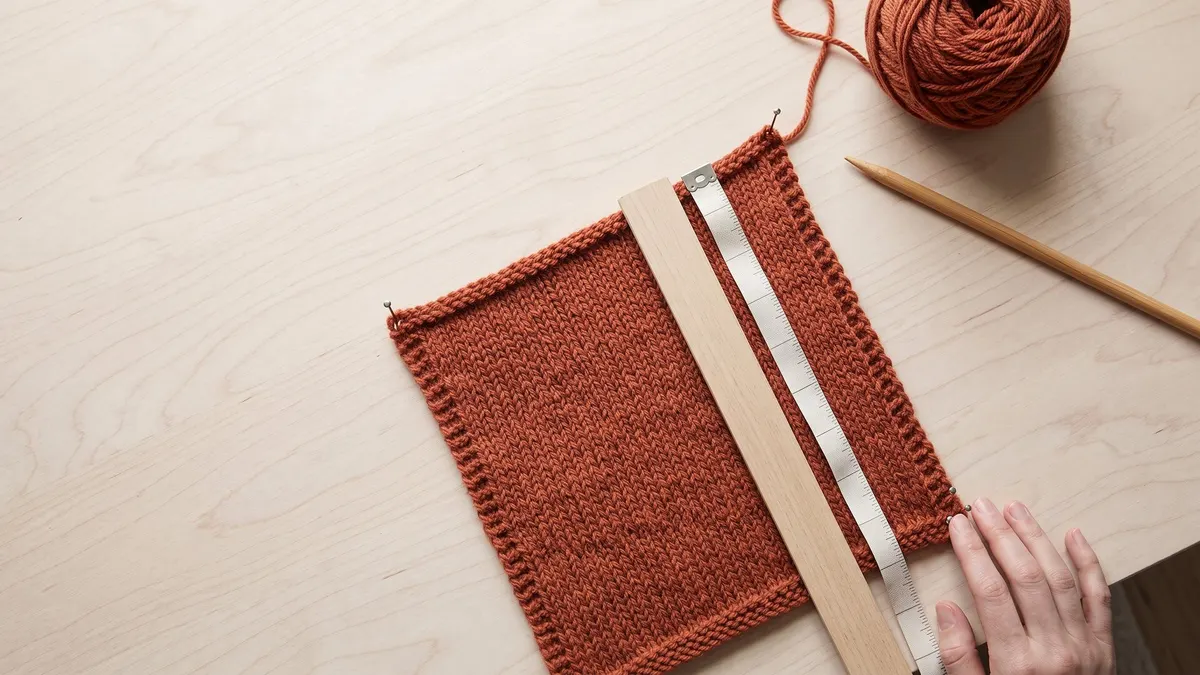
Knit a swatch and calculate stitches per inch. If your gauge is 22 stitches per 4 in10 cm:
22 stitches ÷ 4 in = 5.5 sts/in(or2.2 sts/cm). -
Multiply and cast on
Multiply the target measurement by the stitches per inch, and round to your rib repeat:
20.25 in × 5.5 sts/in = 111.4 → 112 stitches(metric:51.5 cm × 2.2 sts/cm = 113.3 → 112).
Head circumference by age
If you are knitting for someone you can't measure, use the band for their age. The last column is the value the hat calculator uses when you pick that size.
| Age / Group | Head Circumference | Calculator uses |
|---|---|---|
| Newborn | 13 - 14 in33 - 35 cm | 13.5 in34 cm |
| Baby 0-3 months | 14 - 16 in35 - 40 cm | 14.5 in37 cm |
| Baby 3-6 months | 16 - 17 in40 - 43 cm | 16 in41 cm |
| Baby 6-12 months | 17 - 18 in43 - 46 cm | 17.5 in44 cm |
| Toddler 1-2 years | 18 - 19 in46 - 48 cm | 18.5 in47 cm |
| Child 2-5 years | 19 - 20 in48 - 51 cm | 19.5 in49 cm |
| Child 5-12 years | 20 - 21 in51 - 53 cm | 20.5 in52 cm |
| Teen / Adult S | 21 - 22 in54 - 56 cm | 21.5 in55 cm |
| Adult M | 22 - 23 in56 - 58 cm | 22.5 in57 cm |
| Adult L/XL | 23 - 24 in58 - 61 cm | 23.5 in59 cm |
Not sure your gauge is right? The gauge calculator tells you which way to change needles, and gauge in the round explains why a hat wants a swatch that behaves like knitting in the round.
Adjusting for ribbing and pattern repeats
Once you calculate the number of stitches (e.g., 110 stitches), you need to adjust it to fit the ribbing or pattern repeat.
- 1x1 rib (2-stitch repeat): The stitch count must be divisible by 2. (110 is divisible by 2, so it works perfectly).
- 2x2 rib (4-stitch repeat): The stitch count must be divisible by 4. 110 is not divisible by 4, so you should adjust up to 112 or down to 108 stitches.
- Cables or lace repeats: Check how many stitches the pattern repeat covers (e.g., 8 or 12 stitches), and round to the nearest multiple.
Needles and crown decreases
A hat is knit in the round, and a short 16 in40 cm circular needle is the length made for hats and sleeves. When the crown gets too small for the circular, switch to double-pointed needles or magic loop.
For the crown, the increase/decrease assistant works out how to spread a given number of decreases evenly across one round — enter the stitches you have and the stitches you want to end the round with. All our free tools are in the knitting calculator overview.
Frequently Asked Questions
How much negative ease should a hat have?
A hat needs to fit snugly, so you subtract a little before calculating — that is negative ease. Take it as a percentage of the head circumference rather than a fixed number of inches: about 3.5% for a loose slouchy hat, 8% for a standard fit, and 11.5% for a snug beanie. On a 22 in56 cm adult head, 8% is about 1.75 in4.5 cm; on a 14.5 in37 cm baby head the same percentage is only 1.25 in3 cm.
What needle size should I use for a hat?
It depends on your yarn. Check the yarn label for suggestions, knit a swatch, and use our gauge calculator to ensure you match the pattern's gauge.
How many stitches do I need for an adult hat on size US 6 (4 mm) needles?
With typical DK weight yarn (22 stitches per 4 in / 10 cm) and a 22 in56 cm head circumference at a standard 8% negative ease (1.75 in / 4.5 cm, so a 20.25 in / 51.5 cm target), you need 20.25 in × 5.5 sts/in = 111.4 stitches (metric: 51.5 cm × 2.2 sts/cm = 113.3). Round to a number that divides evenly into your ribbing — 112 stitches for a 2×2 rib.