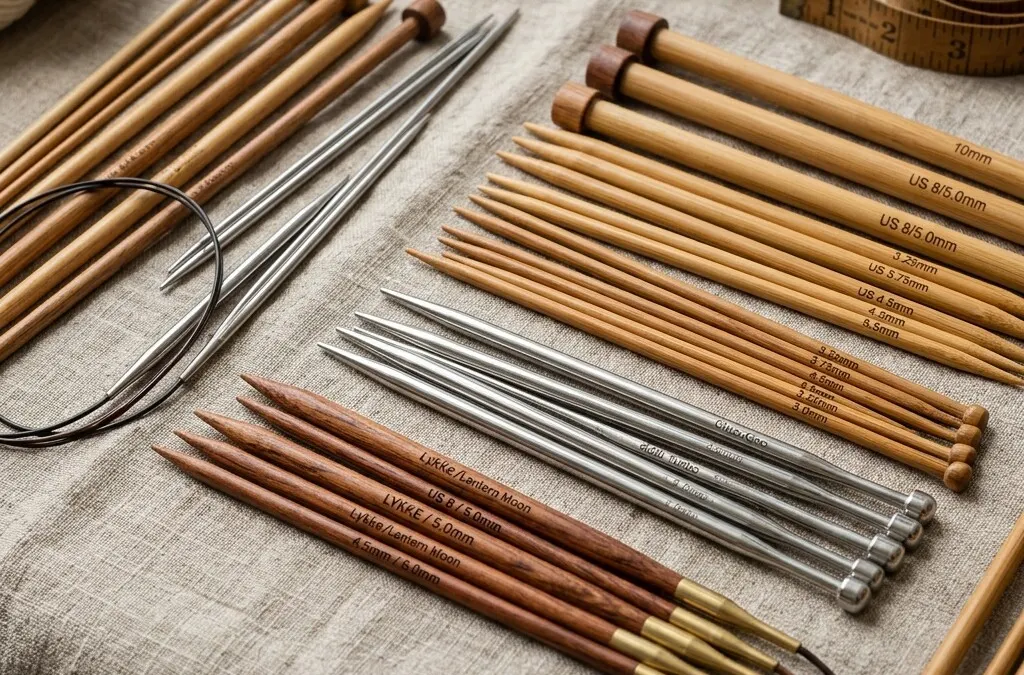
Collection of beautiful bamboo and metal knitting needles
Beginner

Basic Knitting Knowledge

Everything you need to start: needles, yarn, and the first techniques.

Your First Equipment

Choose the Right Needles

As a beginner, we recommend bamboo needles in size 4-5 mm. The bamboo surface provides more friction, so the stitches slide less than on metal needles. This gives you better control when learning your first stitches.

Choose the Right Yarn

Start with a DK or Worsted yarn (gauge 16-24 stitches per 10 cm) in a light color. Light yarn makes it much easier to see your stitches, and thicker yarn gives faster results and is easier to handle.

Your First Project

We recommend a knitted dishcloth as your first project. You only need to know three things: casting on, knit stitches, and binding off. It's a small and manageable project that gives a quick sense of achievement!

Reading Knitting Patterns

Before you start, you should learn how a pattern is structured. Our beginner guide to reading patterns decodes abbreviations, charts, and secret formulas step-by-step.

Yarn Weight Guide

Yarn comes in different thicknesses, often called "weights". This table helps you understand what the different terms mean and which needles are usually used.

Lace

32-40 sts per 10 cm

1.5-2.25 mm

Typical use:
  • Shawls
  • Lace knitting
  • Lightweight wraps

Fingering

28-32 sts per 10 cm

2.25-3.25 mm

Typical use:
  • Socks
  • Light sweaters
  • Baby garments
  • Shawls

Sport

24-26 sts per 10 cm

3.25-3.75 mm

Typical use:
  • Light sweaters
  • Baby garments
  • Accessories

DK

21-24 sts per 10 cm

3.75-4.5 mm

Typical use:
  • Sweaters
  • Cardigans
  • Hats
  • Mittens

Worsted

16-20 sts per 10 cm

4.5-5.5 mm

Typical use:
  • Sweaters
  • Blankets
  • Accessories
  • Home decor

Bulky

12-15 sts per 10 cm

5.5-8 mm

Typical use:
  • Blankets
  • Chunky sweaters
  • Scarves
  • Quick knits

Super Bulky

7-11 sts per 10 cm

8-12.75 mm

Typical use:
  • Blankets
  • Cushions
  • Chunky cowls
  • Speed knitting
Scandinavian Yarn and Gauge
Scandinavian yarn manufacturers like Sandnes Garn, Rauma, and Dale Garn rarely use terms like "DK" or "Worsted" on the ball band. Instead, they print the gauge (stitches per 10 cm) and recommended needle size directly on the label. Use the table above to translate between the systems — which is especially useful when knitting from international patterns. See our full overview of popular yarns in Norway and Scandinavia for more examples and specifications.
How do I find the gauge of my yarn?

Check the ball band around the skein – most manufacturers list the recommended gauge in stitches per 10 cm and a suggested needle size. If you're unsure, knit a 10x10 cm swatch and count the stitches yourself.

Can I substitute a different yarn weight in a pattern?

Yes, but you'll need to recalculate the gauge and often adjust the needle size and yardage needed. Our yarn substitution calculator helps you find the right replacement yarn and figure out how much you need.

What do DK, Worsted, and Fingering actually mean?

These are standard international yarn weight names from British/American tradition. DK ("Double Knitting") is a medium weight, Worsted is slightly heavier, and Fingering is thin yarn often used for socks. See the table above for the full overview.

Ready for the next step?

Once you have control over your equipment and the first stitches, it's time to explore more techniques or look up words in the dictionary.