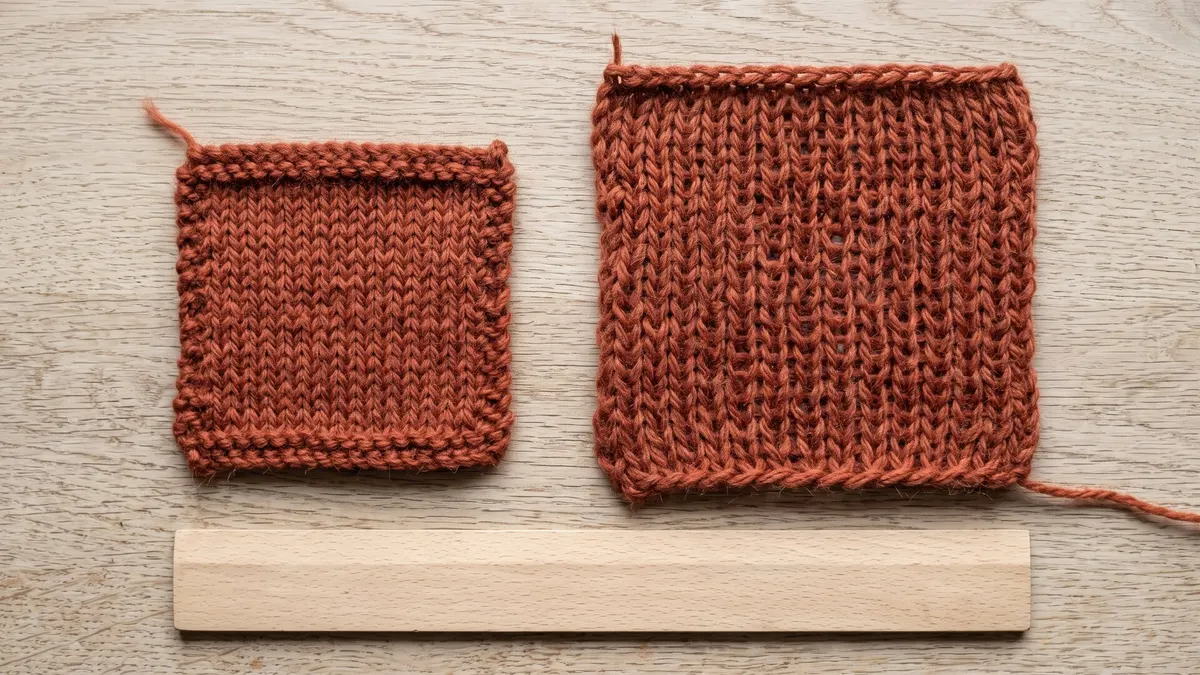
Most fit problems are caused by incorrect gauge and uneven knitting tension. The five most common mistakes are skipping the swatch, not washing it, measuring incorrectly, ignoring row gauge, and not checking along the way. The solution is the same every time: knit a proper swatch and regulate your tension to match the pattern.
A Norwegian version of this page is available on Strikketips.no
The Problem: "I followed the pattern, but the sweater doesn't fit!"
This is perhaps the most frustrating experience in knitting. You've spent weeks on a project, followed the pattern carefully, but when you try on the finished garment, it doesn't fit.
Almost always the cause is gauge — and specifically your personal tension, how tightly or loosely you hold the yarn. This page is the diagnostic: five specific things that go wrong when knitters swatch, what each one looks like, and how to correct it. If you want the theory behind gauge rather than the failure modes, read the complete gauge guide first and come back here when something doesn't add up.
The 5 Most Common Mistakes
-
Skipping the swatch
“I've knitted with this yarn before, so I know my gauge. I don't need a swatch.”
This is the absolute most common mistake. Even professional designers knit a swatch for every single project. You can check your results quickly with our gauge calculator.
The SolutionALWAYS knit a swatch. 30 minutes can save you 30 hours of re-knitting.
-
Not washing and blocking the swatch
“I knitted a swatch and measured — 20 stitches per 4 in10 cm, perfect! Why is the sweater too big after washing?”
Many yarns change dramatically when washed. Wool can bloom, cotton can contract, and acrylic can become looser.
The SolutionWash and block the swatch exactly as you plan to wash the finished garment. Only measure after it has dried completely.
-
Measuring incorrectly
“I laid the ruler on the swatch and measured — 20 stitches per 4 in10 cm!”
How you measure is decisive. Many knitters measure too close to the edge or stretch the swatch while measuring.
The SolutionMeasure in the MIDDLE of the swatch, use pins to mark exactly 4 in10 cm, and count including half stitches. Our gauge calculator handles the arithmetic and the needle recommendation.
-
Ignoring row gauge
“The pattern says 20 stitches and 28 rows per 4 in10 cm. I have 20 stitches, so it's fine!”
Stitch count gives width, but row count gives length — and controls raglan increases, armholes, and all vertical measurements.
The SolutionMeasure BOTH stitches and rows. Adjust shaping or row counts in the pattern if row gauge differs.
-
Not checking gauge along the way
“The swatch was perfect, so I don't need to check anymore. Why is the sweater too big?”
Your gauge can change as you relax, switch from flat to circular knitting, or work in different stitch patterns.
The SolutionCheck the width again after 4–6 in10–15 cm of the main project. It's far easier to fix early!
Once you know what went wrong
Every fix above ends in the same place: change needle size and swatch again. The table below shows which way to go.
| Your swatch | What it means | What to do |
|---|---|---|
| Too many stitches per 4 in10 cm | You knit tighter than the designer | Go up one needle size and swatch again |
| Too few stitches per 4 in10 cm | You knit looser than the designer | Go down one needle size and swatch again |
| Stitch count right, row count off | The width matches, but the length does not | Keep the needles and adjust the pattern's length measurements instead |
Our gauge calculator works out how far off you are and how the difference plays out across a full garment, and the complete gauge guide covers the underlying theory.
Frequently Asked Questions
Why is gauge so important?
Gauge determines how big the finished garment will be. If you have one stitch more or less per 4 in10 cm than the pattern, the sweater can become several sizes too large or too small. It is therefore critical to match the pattern's gauge.
Do I really have to knit a swatch every time?
Yes! Even if you've knitted with the same yarn and needles before, your gauge can vary between projects. Mood, tension, and even the time of day can affect how you knit. 30 minutes with a swatch can save you many hours of re-knitting.
What do I do if the gauge doesn't match?
If you have too many stitches per 4 in10 cm, you're knitting too tightly - switch to thicker needles. If you have too few stitches, you're knitting too loosely - switch to thinner needles. Adjust one needle size at a time and knit a new swatch.
Can I just adjust the number of stitches instead?
No, this rarely works well. The pattern is designed with a specific gauge in mind. If you change the number of stitches, the proportions will be wrong - armholes may become too large, the neckline wrong, etc.
Why does gauge change after washing?
Many yarn types change when they are washed for the first time. Wool can 'bloom' (become airier), cotton can contract, and acrylic can become looser. Therefore, you must always wash and block the swatch before measuring.