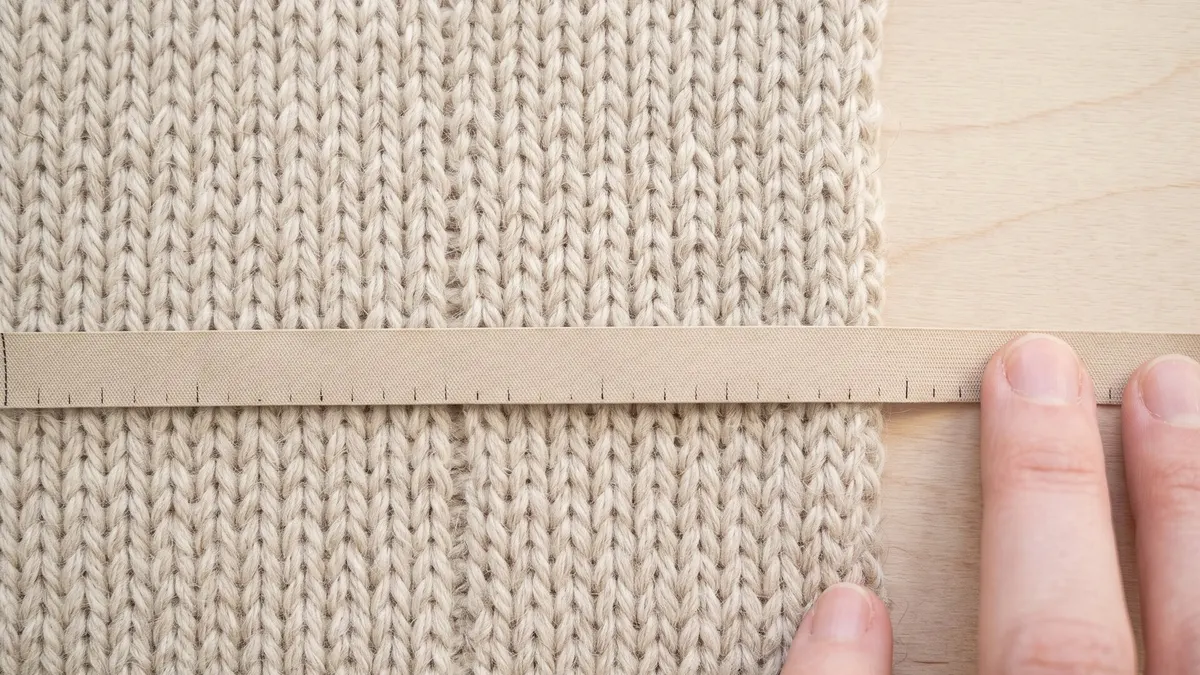
Knit a square at least 6 in15 cm each way in the pattern's stitch, wash it the way you'll wash the garment, let it dry, then count stitches and rows over 4 in10 cm in the middle. That is the whole method. The rest of this page is about the ways each step goes wrong.
How big should a gauge swatch be?
Bigger than the 4 in10 cm you are going to measure. The stitches along the edges of any knitted piece are looser and less even than the ones in the middle, and on a swatch that is only 4 × 4 in10 × 10 cm those edge stitches are most of what you have. Aim for at least 6 in15 cm in both directions, so you can lay the ruler down with a margin on every side.
To turn that into a cast-on number, take the pattern's stitches per 4 in10 cm, divide by 4 and multiply by 6. A pattern at 20 sts per 4 in10 cm gives 30 stitches; at 28 sts, 42.
Knitting the swatch
- Same yarn, same needles. The exact yarn and needle size you plan to use for the project — not a similar ball from the stash.
- Same stitch. The stitch the pattern states its gauge in, usually stockinette. Never measure the main gauge over ribbing: ribbing has its own, denser gauge.
- Same construction. If the project is knit in the round, the swatch should behave like knitting in the round. Gauge in the round vs. flat shows a quick way to do that without knitting a tube.
Wash and block it first
Many yarns change when they meet water for the first time. Whatever your yarn does, it will do it to the finished garment the first time you wash it, so you want it to happen to the swatch first, while the number is still useful.
-
Wash it like the garment
If the garment will be washed by hand and laid flat, do that. If it will go in the machine, put the swatch through the machine.
-
Let it dry completely
In our experience damp knitting measures differently from dry knitting. Wait until it is dry all the way through.
-
Don't pin it under tension
Let it settle on a flat surface. If you stretch it into shape, you measure a fabric the garment will never be.
Superwash-treated yarn can grow noticeably when wet. Never measure a superwash swatch before it has been washed and is completely dry — a garment built on the unwashed number can come out of its first wash too big.
Measuring stitches and rows
Lay the swatch on a table. Don't hold it in the air and don't smooth it out with your hand — knitting is elastic, and helping it along even slightly changes the number.
- Stay away from the edges. Keep the ruler at least three or four stitches in from the sides, and several rows away from the cast-on and bind-off.
- Mark the span. Push a pin or a locking stitch marker through the fabric at each end of the 4 in10 cm before you count, so the ruler can't drift.
- Count half stitches. A half stitch per 4 in10 cm is precision you knitted the swatch for; don't round it away.
- Measure in two or three places. Handknitting is never perfectly even, and a single reading can easily be half a stitch off. Use the average.
- Count rows too. The same way, vertically. Row gauge decides where shaping lands.
Can't find a clean 4 in10 cm? Count across whatever width you can measure and scale it: stitches per 4 in = counted stitches ÷ measured width in inches × 4. 24 stitches over 4.8 in12 cm is 20 sts per 4 in10 cm. The gauge calculator does this for you and compares the result with the pattern.
What different fibers do in the wash
This is what we have seen in our own swatches, not a rule for every yarn in a category — the spin, the treatment and the dye all play in. Treat it as a reason to wash the swatch, not as a replacement for doing it.
| Fiber | What we've seen | What to watch for |
|---|---|---|
| Untreated wool | "Blooms" — stitches even out and fill small gaps | The swatch can come out slightly wider than before washing |
| Superwash wool | Relaxes a lot and can grow | Only ever measure it washed and dry |
| Cotton | Little elasticity, can shrink somewhat, especially in length | Row gauge shifts more than stitch gauge |
| Alpaca | Can lengthen after washing | Most noticeable on larger garments |
| Acrylic and synthetics | Change little when washed, but lose bounce if stretched hard | Block gently; never stretch the swatch |
If your numbers still don't match after an honest swatch, the causes and fixes are in gauge errors. For how gauge fits together as a whole, start at all about knitting gauge.
Frequently Asked Questions
How many stitches should I cast on for a gauge swatch?
Enough for 6 in (15 cm) of width at the pattern's gauge: the pattern's stitches per 4 in, divided by 4, times 6. For a pattern at 20 sts per 4 in (10 cm) that is 30 stitches.
Can I measure gauge over ribbing?
No. Ribbing pulls in and always gives a denser gauge than stockinette. Measure the main gauge over the stitch the pattern names, and swatch the ribbing separately only if the pattern gives a rib gauge.
Should I count half stitches?
Yes. Rounding to whole stitches throws away exactly the precision you knitted the swatch for — half a stitch per 4 in10 cm adds up across a sweater.
My swatch isn't exactly 4 inches wide. Can I still use it?
Yes. Count the stitches across any width you can measure cleanly and scale: stitches per 4 in = counted stitches ÷ measured width in inches × 4. The gauge calculator does the same arithmetic.