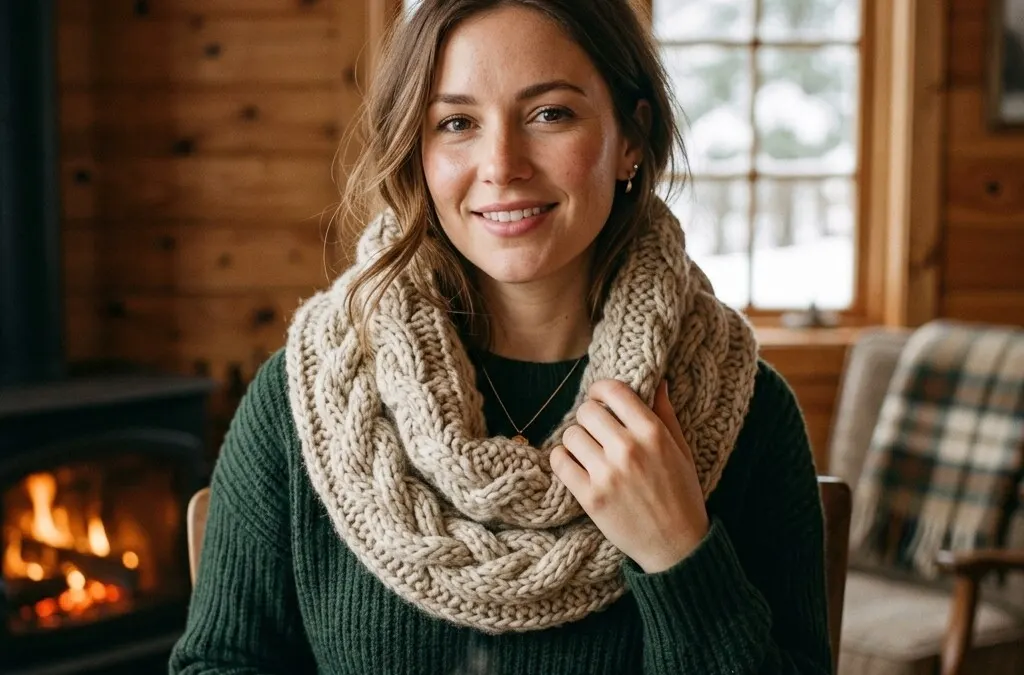
Knitting a cowl (or neck warmer) is a good next step after your first dishcloth: a tube knit in the round, with no shaping and no seams, and much less knitting than a scarf. Further down you'll find a free pattern in three sizes – child, women and men – in three different yarn weights.
A Norwegian version of this page is available on Strikketips.no
Why is a cowl the perfect first project?
A tube cowl is simply a cylinder. You don't have to worry about increases and decreases to shape the garment, and you can just knit round and round on a circular needle until it's long enough. You also end up with a garment that has dual functions: warmth, and the ability to pull it up over your nose on the coldest days!
What you need
Before you start knitting your cowl, make sure you have the following tools and materials ready:
Free pattern: Cowl in three sizes
A simple, classic cowl knitted in the round in ribbing (knit 2, purl 2) throughout – stretchy, warm and completely seamless. The pattern is written for three sizes and three yarn weights, so you can use the yarn you love.
Stitch counts and needle sizes
Pick the row that matches your yarn. The stitch counts are the centimeter circumference times the stitches per cm, rounded to the nearest multiple of 4 so the ribbing works out evenly. Important: The gauge in the table is given for ribbing (knit 2, purl 2), measured slightly stretched. Swatch in ribbing – not stockinette – to get the correct stitch count.
| Yarn weight | Gauge | Needle | Child | Women | Men | Yarn needed |
|---|---|---|---|---|---|---|
| Chunky / bulky | 12 sts = 4 in / 10 cm | US 11 / 8 mm | 52 sts | 64 sts | 68 sts | 5–9 oz150–250 g |
| Worsted / aran | 18 sts = 4 in / 10 cm | US 8 / 5 mm | 80 sts | 92 sts | 100 sts | 3.5–7 oz100–200 g |
| DK / lighter | 22 sts = 4 in / 10 cm | US 6 / 4 mm | 96 sts | 116 sts | 124 sts | 3.5–5 oz100–150 g |
Instructions
- Cast on the stitch count for your size and yarn weight on a 16 in / 40 cm circular needle. Use a stretchy cast-on – the Italian cast-on gives the neatest edge on ribbing. The long-tail cast-on over two needles held together is an easier alternative.
- Join in the round: Place a stitch marker at the beginning of the round, and make sure the cast-on isn't twisted around the needle before you knit the first round.
- Work the ribbing: Knit 2, purl 2 round after round until the piece measures 8 (10, 11) in / 20 (25, 28) cm, or your desired height.
- Bind off loosely: Preferably with the Italian bind-off – it gives an invisible, elastic edge that matches the cast-on. An easier alternative: bind off in pattern (knit the knits and purl the purls) using a needle 1–2 sizes larger, and the edge will be stretchy enough.
- Weave in the ends on the wrong side with the tapestry needle – and your cowl is ready to wear!
Note: Always check your gauge against the table with a small swatch first. If you knit tighter or looser than stated, change needle size – or calculate your own stitch count in the section below.
Calculate stitch counts for your own yarn
Have a yarn that doesn't match the table? The math is simple: stitch count = circumference in inches × (stitches per 4 in ÷ 4), rounded to the nearest multiple of 4. Example: a women's cowl of 20.5 in52 cm with a gauge of 18 stitches per 4 in10 cm gives 20.5 × (18 ÷ 4) = 92.25 ≈ 92 stitches (metric: 52 × 1.8 = 93.6 ≈ 92). The table above was calculated from the centimeter measurements, so for some yarns the inch formula lands one repeat of 4 away from it — either count works; swatch and pick the fit you want.
Knit a swatch and measure your gauge accurately – use our gauge calculator to check your swatch, or our other knitting calculators for yarn amounts and conversions.
Common mistakes and solutions
The problems we see most often on cowls, and how to fix them:
If the cast-on twists when you join in the round, the cowl becomes a permanent spiral instead of a tube. Solution: Lay the circular needle flat on a table after casting on and check that all stitches point inward (toward the center of the circle) before you knit the first round. An extra trick: work the first two rows flat (back and forth), then seam the small gap afterward with the tail.
A cast-on or bind-off that is too tight can make the cowl impossible to pull over your head. Solution: Always use a stretchy cast-on (see above), and bind off with a needle 1–2 sizes larger. If you've already finished, soaking and blocking the edge can relax it a little; otherwise, re-do the bind-off looser.
If the cowl has tight and loose sections, the cause is uneven yarn tension. Solution: Knit a swatch first to practice a steady rhythm. In our experience small unevenness in ribbing softens after the first wash.
Stockinette stitch curls at the edges – it's a property of the stitch, not a mistake — and the roll takes up some of the height you knitted. Solution: Use ribbing, seed stitch or textured patterns instead, or add at least 2 in / 5 cm of ribbing at both ends (see the variation above).
Knitting a cowl in the round
We knit cowls on a 16 in40 cm circular needle — the short length for hats and sleeves, which a cowl's circumference fits around without stretching — and there is no seaming. If you only have a long circular needle (32–40 in / 80–100 cm), you can knit the cowl with the magic loop technique instead – then any cable length works.
If you prefer straight needles, you can also knit the cowl flat as a rectangle and seam it with mattress stitch at the end – see the finishing guide for an invisible seam.
Choose the softest yarn
The cowl lies against the skin under your chin and around your neck, so we'd skip coarse wool meant for outerwear and choose something soft — merino, alpaca or a cashmere blend. Holding a fluffy yarn like mohair or brushed alpaca together with a wool yarn gives a fuzzy, halo surface.
Remember that a wool or alpaca cowl needs a little care to stay beautiful over time – see our guide to washing and caring for knitwear for tips on gentle hand-washing and drying.
Frequently asked questions
What yarn is best for a cowl?
Something soft, since the cowl sits against your neck and face. We choose merino, alpaca or a cashmere blend.
How many stitches do I need for a cowl?
It depends on your yarn weight and gauge. With chunky yarn (12 stitches per 4 in / 10 cm) a women's cowl needs around 64 stitches, with worsted (18 sts) around 92, and with DK (22 sts) around 116. See the pattern table in the guide for all sizes, or calculate from your own swatch as shown in the guide.
How tall should a knitted cowl be?
Our pattern uses 8 in20 cm for a child, 10 in25 cm for women and 11 in28 cm for men. Knit it taller if you want to fold the edge double or pull it up over your chin.
Can I knit a cowl without a circular needle?
Yes! Knit the cowl flat back and forth on straight needles as a rectangle, and seam it into a tube at the end. Use mattress stitch for a nearly invisible seam – see our finishing guide for how to seam knitwear neatly.
How much yarn do I need for a cowl?
Our pattern's adult sizes take roughly 3.5–7 oz100–200 g of worsted yarn, 5–9 oz150–250 g of chunky yarn, or 3.5–5 oz100–150 g of DK yarn. Your yarn's yardage decides the exact amount — our yarn calculator can estimate it from your own swatch.
How do I stop the edges of my cowl from curling?
Stockinette stitch always curls at the edges – that's why our pattern uses ribbing (knit 2, purl 2) throughout. If you want stockinette in the middle, knit at least 1.5–2 in4–5 cm of ribbing at the bottom and top to keep the edges flat.
What do I do if the cowl is too tight over my head?
The cast-on or bind-off edge isn't elastic enough. Soaking and blocking can relax it a little; otherwise re-do the bind-off looser. Next time, use the Italian cast-on (or a long-tail cast-on over two needles), and bind off with a needle 1–2 sizes larger or use the Italian bind-off.
Can I use a different stitch pattern instead of ribbing?
Yes. Seed stitch (knit 1, purl 1, offset every round) gives a textured surface that lies flat. Avoid pure stockinette unless you want a deliberate rolled edge.