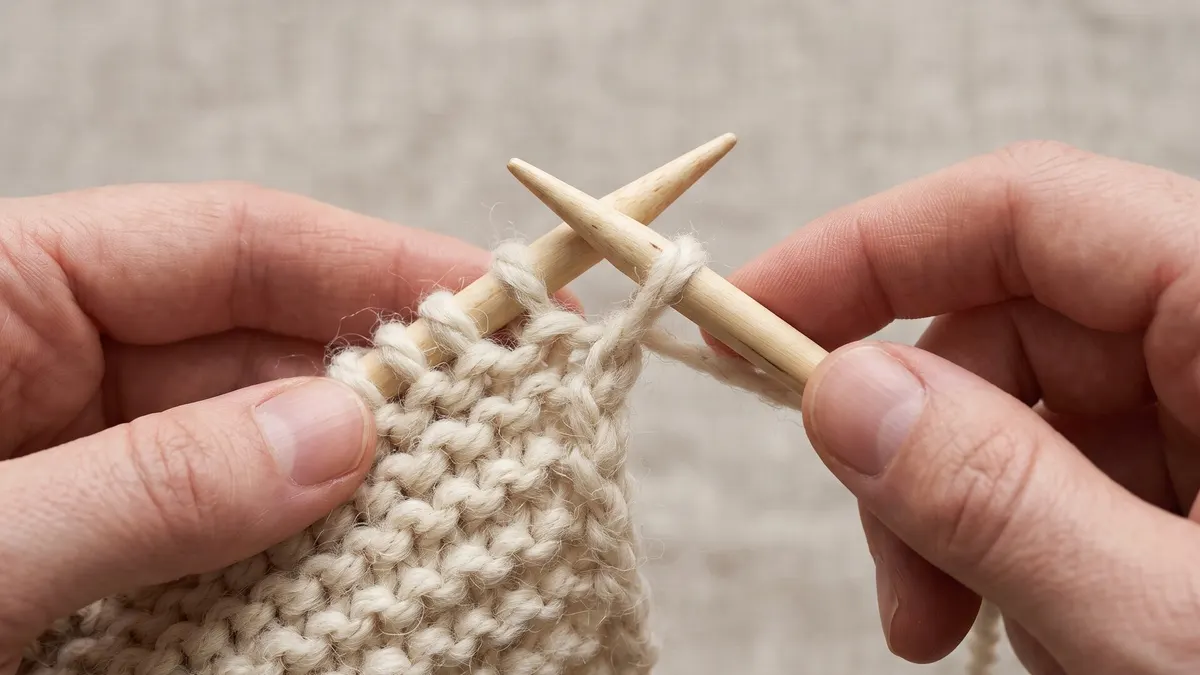
The dishcloth is worked in garter stitch, knitting every row. You knit until the piece is as tall as it is wide, so there is no exact measuring along the way.
Pattern at a glance
Materials and Yarn Choice
One skein is enough for the whole dishcloth:
Yarn
1 skein (1.8 oz50 g) in DK weight, approx. 115–137 yards105–125 meters
Knitting Needles
Straight or circular needles, US 64 mm (optionally US 74.5 mm–US 85 mm for binding off)
Notions
Blunt tapestry needle, measuring tape, and scissors
Choose a smooth DK-weight yarn with clear stitch definition so you can easily see every stitch on the needle. Two specific options that match US 64 mm needles and finish with a single 1.8 oz50 g skein:
- Paintbox Yarns Cotton DK: 100% cotton, 1.8 oz50 g = approx. 137 yards125 meters, stated gauge 22 sts × 30 rows over 4 × 4 in10 × 10 cm on US 64 mm needles.
- DROPS Cotton Light: 50% cotton and 50% polyester micro, 1.8 oz50 g = approx. 115 yards105 meters, stated gauge 21 sts × 28 rows over 4 × 4 in10 × 10 cm on US 64 mm needles.
If you want to use another yarn from your yarn shop, look for a smooth cotton or cotton-blend yarn with a recommended US 64 mm needle and a stated gauge around 21–22 sts per 4 in10 cm (DK weight).
Yarn specifications sourced from Garnstudio and LoveCrafts.
Gauge and Sizing
With 50 stitches and DK yarn on US 64 mm needles (21–22 sts per 4 in10 cm), the dishcloth comes out roughly 9.1 in23 cm wide. Yarn labels always state gauge in stockinette stitch, whereas this dishcloth is worked in garter stitch. Because of that, the exact width and height can vary a little depending on how tightly or loosely you knit.
On a dishcloth, a fraction of an inch makes no difference in use. By knitting until the height matches your own width, you get a neat square cloth regardless of your personal gauge.
Stitches bunch together on the needle, making the piece look narrower than it really is. Lay the cloth flat on a table and measure a bit below the needle when checking width and height. To learn more about checking gauge for garments, see our knitting gauge guide or try our gauge calculator.
The Pattern
- 01
Cast on 50 stitches
Use a standard long-tail cast-on. Measure out roughly 60 in1.5 m of tail yarn before you start (the rule is about 1 in2.5 cm per stitch plus 6 in15 cm for weaving in, so about 56 in1.4 m for 50 stitches).
Make a slip knot and place it on the needle: it counts as your very first stitch. Then cast on 49 more stitches so you have 50 stitches total on the needle. Avoid pulling the stitches too tight around the needle; the loops should slide smoothly back and forth.
- 02
Knit garter stitch until the cloth is square
Now work the knit stitch back and forth until the dishcloth forms a square:
- Hold the needle with the 50 stitches in your left hand and the empty needle in your right hand. Check that the working yarn rests behind the needle (away from you), not wrapped over the tip.
- Knit all 50 stitches onto the right-hand needle.
- Turn your work: move the needle holding the stitches into your left hand and take the empty needle in your right hand. The working yarn is now at the tip of the left needle, ready for the next row.
- Knit all 50 stitches back again. Every two rows (one row across and one back) creates one horizontal ridge: that ridge pattern is called garter stitch.
Repeat until the dishcloth is as tall as it is wide (around 9.1 in23 cm). A quick way to check as you go is to lay the cloth flat and fold the bottom left corner diagonally up to the top right corner right under the needle: when the side edge and cast-on edge meet along a clean fold, the cloth is square.
- 03
Bind off loosely
Once the dishcloth is square, lock the stitches off so they cannot unravel. You can follow the same steps as in our bind-off guide:
- Knit the first two stitches.
- Insert the tip of your left needle into the first stitch on the right needle, lift it up and over the second stitch, and drop it off the tip. You now have one stitch bound off and one stitch left on the right needle.
- Knit one new stitch, then lift the back stitch on the right needle over the front stitch.
- Repeat step 3 all the way across the row until only one stitch remains on the right needle.
Cut the working yarn leaving an approx. 5.9 in15 cm tail, pull the cut end straight through the final stitch loop, and gently snug it closed. Tip: If you bind off tighter than you knit, the top edge pulls inward. If you notice your stitches tightening up, switch to a needle one or two US sizes larger (US 74.5 mm or US 85 mm) just for the bind-off row.
- 04
Weave in the ends
You now have two loose yarn tails of about 5.9 in15 cm each: one at the cast-on edge and one where you bound off. Thread one tail onto a blunt tapestry needle (a blunt tip glides between the yarn plies instead of splitting them).
Carefully weave the needle 1.2–1.5 in3–4 cm along the garter ridges on one side of the cloth. Skip the outermost yarn loop and weave 0.8–1.2 in2–3 cm back in the opposite direction so the tail locks without a knot. Repeat with the second tail. Give the corner a gentle tug so the yarn settles before trimming the excess close to the fabric.
The cast-on tail rule is from Marly Bird (about 1 inch per stitch plus 6 inches for weaving in) and Dummies (about 1 inch per stitch plus a little extra), read 2026-11-16.
Washing, Care, and an Easy Variation
Once the ends are woven in, your dishcloth is ready to use. Always follow the care instructions on the label of the yarn you chose: Paintbox Yarns Cotton DK, for example, is labeled for machine wash at 104°F40°C and not for tumble drying.
If you want to knit a second dishcloth with extra texture, try seed stitch. Cast on 51 stitches (an odd number) instead of 50, repeat "knit 1, purl 1" across the row, and end with knit 1, on every single row. Because the stitch count is odd, every knit stitch automatically lands above a purl stitch on the next row, creating a textured, bumpy fabric on both sides.
Frequently Asked Questions
How much yarn do I need for one knitted dishcloth?
One 1.8 oz50 g skein in DK weight (approx. 115 yards105 meters to 137 yards125 meters) is enough for one dishcloth measuring about 9.1 in23 cm square.
How do I know when the dishcloth is square without a measuring tape?
Fold the bottom corner diagonally up toward the opposite top corner, right below the needle. When the cast-on edge and the side edge line up cleanly to form a triangle, the height matches the width.
Why is the top edge of my dishcloth narrower than the cast-on edge?
Garter stitch does not curl at the edges, so that is not the cause. More likely the bind-off is too tight, since a tight bind-off pulls the top stitches inward. Next time, switch to a needle one or two US sizes larger (US 74.5 mm or US 85 mm) just for the bind-off row.