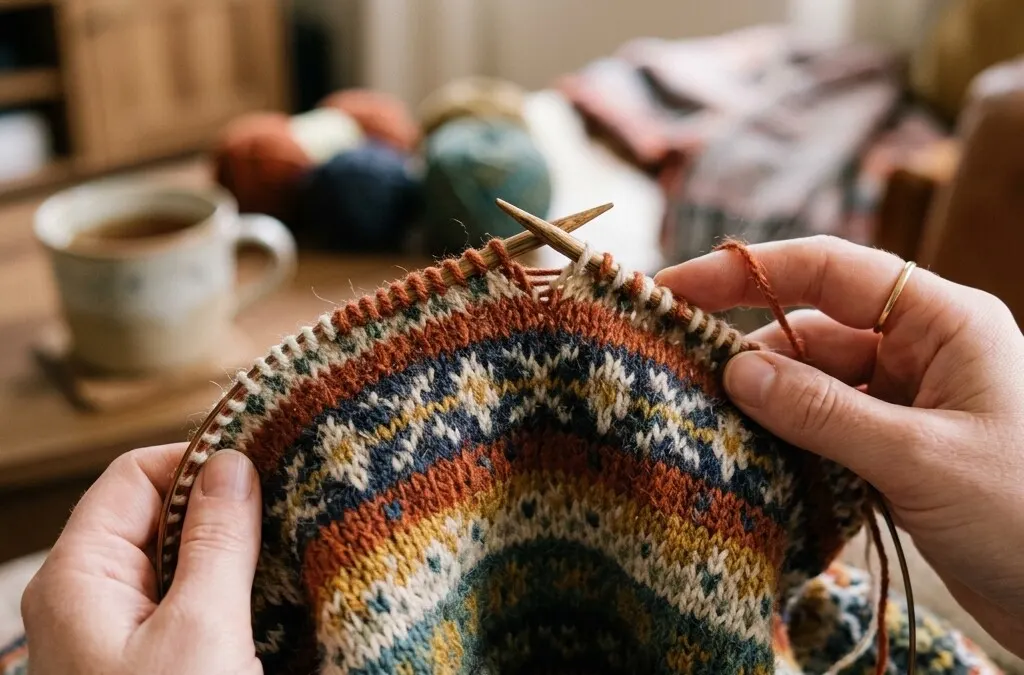
Stranded colorwork means knitting with two colors in the same round, letting the one you're not using float across the back. Read the chart from the bottom up and, in the round, from right to left. Keep the floats loose, and swatch in pattern before you cast on.
If you can knit and purl and have finished a plain hat, you have the skills for knitting colorwork. What's new is handling two yarns at once and keeping the strand behind the work the right length. That is most of what this guide is about.
A Norwegian version of this page is available on Strikketips.no
What is stranded colorwork?
Colorwork is any knitting where two or more colors appear in the same row or round. Stranded colorwork is the kind where both colors travel all the way along the round: you knit a stitch in one, and the other runs loosely along the back (the wrong side) until it's needed again. That loose strand is a float.
You'll often hear it called Fair Isle. Strictly, Fair Isle is one tradition of stranded knitting, named after the island in Shetland. The other main colorwork methods work differently: intarsia uses a separate ball for each block of color and carries no floats, and mosaic knitting uses one color per row and makes the pattern with slipped stitches.
Reading a colorwork chart
The pattern comes as a grid. One square is one stitch; one row of squares is one round. Each square is colored (or marked with a symbol) to show which yarn that stitch is knit in.
In the round you knit from right to left, so you read the chart the same way: start at the bottom right corner, read to the left end of the row, then move up one row and start again at the right. Knitting in the round also means you always face the right side of the pattern, which makes the color changes easier to follow. The general rules for charts are in how to read a knitting pattern.
Holding two colors
- Both over the left index finger: tension both strands over your left index finger and pick the color you need, Continental-style.
- One on the index finger, one on the middle finger: keeps a gap between the colors so the strands don't twist around each other.
- One in each hand: main color in the left hand (Continental), contrast color in the right (English, or "throwing"). The strands never tangle, and each color stays in the same position.
None of these is the right one; use whichever gives you an even rhythm. What matters is that you keep each color in the same position — above or below the other — for the whole piece.
Changing which color sits above and which below partway through can show in the fabric: in our experience the color held below comes out slightly more prominent. Pick an arrangement at the start — we put the contrast, pattern color below — and don't swap.
Floats: the whole trick
Puckered colorwork — fabric that draws in and won't block flat — comes from floats that are too short. Each float has to span the same distance on the back as the stitches it crosses on the front. The instinct is to pull the strand snug, and that is exactly what draws the fabric in.
Spread the stitches already on the right needle out to their full width before you knit with the other color. The float then has enough length to lie flat behind them without pulling them together.
Floats can also be too long — a long loop on the inside catches on fingers or buttons. When a color isn't used for many stitches, catch the float into the back of the work partway along. We catch floats that span more than about five stitches; your pattern may give its own number.
Swatch in pattern
Stranded fabric is denser and less stretchy than plain stockinette in the same yarn, because the floats bind it. Its gauge is different, so a stockinette swatch won't tell you what you need. Swatch in the colorwork pattern — and in the round if the garment is knit in the round (gauge in the round shows a quick way). If your colorwork comes out smaller than the pattern's gauge, a larger needle for the colorwork section is the usual fix; the swatch tells you whether you need it.
Choosing yarn for colorwork
We reach for non-superwash wool with some grip. The fibers hold onto each other, which helps even out the stitches between colors, and a slightly rustic wool is also the kind that tolerates steeking — cutting a knitted tube open for a cardigan front or armholes. Superwash wool and smooth fibers like cotton show uneven tension more, and a superwash steek has to be secured thoroughly or it will unravel.
Frequently Asked Questions
Is Fair Isle the same as stranded colorwork?
Fair Isle is one kind of stranded colorwork, named after the island in Shetland, and traditionally uses two colors per round. "Stranded colorwork" is the general term for any knitting where two colors are carried along the round with the unused one floating behind.
Why is my colorwork tight and puckered?
The floats on the back are too short. Each float has to span the same distance as the stitches it crosses on the front; pulled tight, it draws the fabric in, and blocking won't fully fix it. Spread the stitches out along the right needle before you switch colors.
Which yarn is best for colorwork?
We reach for non-superwash wool with a bit of grip. The fibers hold onto each other, which helps even out the stitches between colors. Slick yarns — superwash wool, cotton — show uneven tension more and are riskier if the garment will be steeked.
Can I knit stranded colorwork flat?
You can, but you then strand on purl rows too, and follow the chart from left to right on the wrong side. That is why stranded garments are usually knit in the round, and cardigans are often knit as a tube and cut open — steeked — afterward.