A Norwegian version of this page is available on Strikketips.no
What are German Short Rows?
German Short Rows are one of the most popular and modern methods for creating three-dimensional shape in knitwear. The technique is commonly used for short-row sock heels, back-neck shaping in top-down sweaters, and shoulder shaping.
Traditionally, methods like "wrap and turn" (W&T) were used to avoid holes when turning your work mid-row. German Short Rows simplify this process significantly: instead of wrapping the yarn around a stitch, you knit to the turning point, turn your work, and slip the first stitch while pulling the yarn tightly to the back. This action pulls the stitch up over the needle, turning it into a double stitch. When you work over this double stitch on a later row, you simply knit (or purl) both loops together as a single stitch, leaving a virtually invisible join with no holes or bulk.
See how it's done (video)
Sometimes it's easier to see the technique in action. Here is a video showing German Short Rows step-by-step for both the right side (RS) and wrong side (WS):
Step-by-step instructions
Here is how to make the turn on the right side (RS) and wrong side (WS) of your work.
- 01
Turning on the right side (RS)
- Knit to the turning point. Turn your work.
- Slip the first stitch purlwise to the right needle with the yarn in front of the work.
- Pull the yarn tightly over the needle to the back. You will see both legs of the stitch below pulled up onto the needle – this is your double stitch. Make sure to pull it tight! Keep the yarn in back to purl the next stitch (or continue according to your pattern).
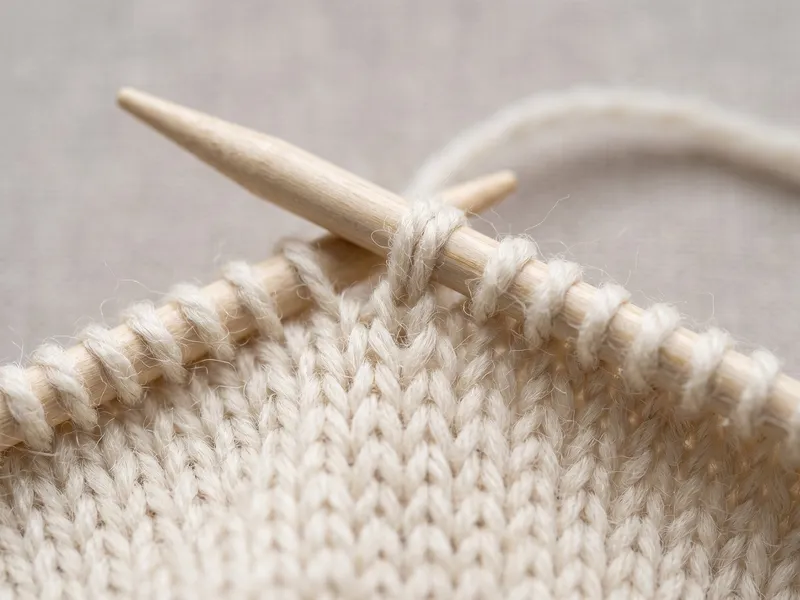
Pulling the yarn firmly backwards pulls the stitch legs up over the needle, creating a distinct double stitch. - 02
Turning on the wrong side (WS)
- Purl to the turning point. Turn your work.
- With the yarn in front of the needle (towards you), slip the first stitch purlwise.
- Pull the yarn tightly over the needle to the back, pulling the purl bumps up to create the double stitch. Bring the yarn back to the front between the needles if you need to purl the next stitch, or leave it in the back if you are knitting.
When you encounter a double stitch on subsequent rows, treat it as a single stitch. Insert your needle under both legs of the double stitch at the same time and knit (or purl) them together as one. Tighten the yarn slightly on the next stitch to make sure the transition is completely gap-free.
Frequently Asked Questions
Can I replace 'wrap and turn' (W&T) with German Short Rows?
Yes, almost always! When a pattern tells you to W&T, you can usually knit to the stitch where you were supposed to wrap, turn, and instead create a double stitch as described here.
Why do I sometimes get holes even with this technique?
The most common issue is not pulling the double stitch tight enough over the needle. Also, make sure to tighten the yarn when knitting the subsequent stitch.