Magic Loop: Knit Small in the Round
Forget double-pointed needles falling out! Magic Loop lets you knit small circumferences like socks, sleeves, and mittens with just one long circular needle.
What is Magic Loop?
Magic Loop is a technique where you use a circular needle that is much longer than the circumference of what you are knitting. By pulling out the cable in one or more loops, you can knit in the round on even the smallest garments without the need for double-pointed needles.
Why choose Magic Loop?
- Fewer needles: You only need 1 long circular needle instead of 5 short ones.
- No gaps: Reduces the risk of "ladders" (loose stitches) between needles.
- Knit two at once: You can knit two sleeves or two socks at the same time on the same needle!
- Flexible: You can use the same needle for both the body and the sleeves of a sweater.
What you need
To use Magic Loop, you need a circular needle with a soft and flexible cable. The length should be at least 32 in80 cm, but 40 in100 cm is often even better for getting good loops.
How to do it (Step-by-step)
Divide stitches in half
Slide half of your stitches onto each side of the long circular needle cable (at least 32 in / 80 cm).
Pull out cable loop
Gently pull the cable out halfway between the stitches, forming a flexible loop on the side.
Free the back needle
Draw the back needle tip out so it becomes your working needle, ready to knit across the front stitches.
Knit and rotate
Knit across the front needle, rotate the work 180°, push the needle back in, and repeat for the other half.
Magic Loop splits the stitches onto two parallel needle sections, letting the flexible cable absorb the extra circumference.
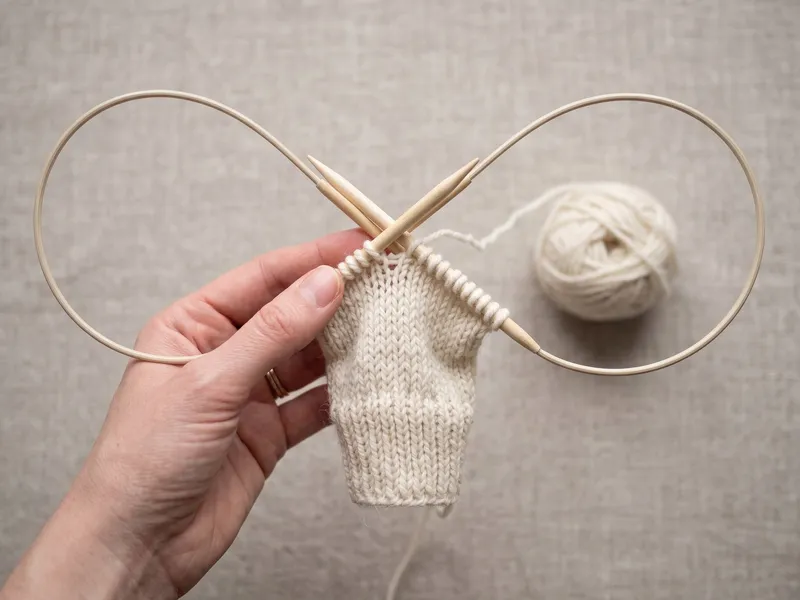
- Cast on and divide: Cast on all stitches on the circular needle. Slide them to the middle of the cable and divide the stitches into two equal parts.
- Create the loop: Pull the cable out between the two groups of stitches so that a large loop sticks out.
- Prepare for knitting: Slide the stitches on one half onto the left needle tip. The other half (where the yarn hangs) should sit on the cable at the back.
- Knit the first side: Pull out the back needle (the one with the yarn) and start knitting the stitches on the front needle.
- Turn and repeat: When the needle is empty, turn the work. Slide the stitches from the cable onto the left needle, pull out the right needle, and continue.
Tips for "ladders"
To avoid a loose stripe where the loop sticks out, you should tighten the yarn a little extra on the first and second stitch after you have switched sides. This "locks" the stitches together and gives a smooth result.
Magic loop for sleeves
Sleeves are where Magic Loop truly shines: the circumference keeps shrinking toward the cuff, and with Magic Loop you never need to switch to shorter needles or double-pointed needles along the way. Divide the stitches so the decrease line under the arm sits at one of the loops – that way you always know where the decreases happen.
If you are knitting a sweater, you can even knit both sleeves at the same time on the same needle (from separate balls of yarn). The sleeves are guaranteed to end up the same length, and you skip the dreaded "second sleeve" slump. See our sweater guide for the whole process.
Magic loop for socks
Socks on Magic Loop divide naturally in two: the top of the foot on one needle half and the sole on the other. The heel and toe sit clearly defined on their own halves, which makes both heel and toe shaping easier to track than on double-pointed needles.
Here too you can knit two socks at the same time – popular precisely because both are finished together. New to sock knitting? Our sock guide walks through the whole construction from cuff to toe.
See how it's done
Sometimes it's easier to see the technique in action. Here is a good video showing how to knit with Magic Loop:
Video from Nimble Needles
Frequently Asked Questions
How long should the circular needle be for Magic Loop?
At least 32 in80 cm, but 40 in100 cm often works even better since it's easier to pull out a big enough loop.
Can I use Magic Loop for larger projects too?
Yes, the technique works for any circumference, not just the smallest ones. Many knitters use it for everything from mittens to entire sweaters.
How do I avoid a "ladder" where the loop turns?
Pull the yarn a bit tighter on the first two stitches after switching sides. This locks the stitches together and gives a more even result.
Is Magic Loop harder than double-pointed needles?
The method takes some getting used to, but many knitters find it easier in practice since you no longer have to juggle several loose needles at once.
Published Updated