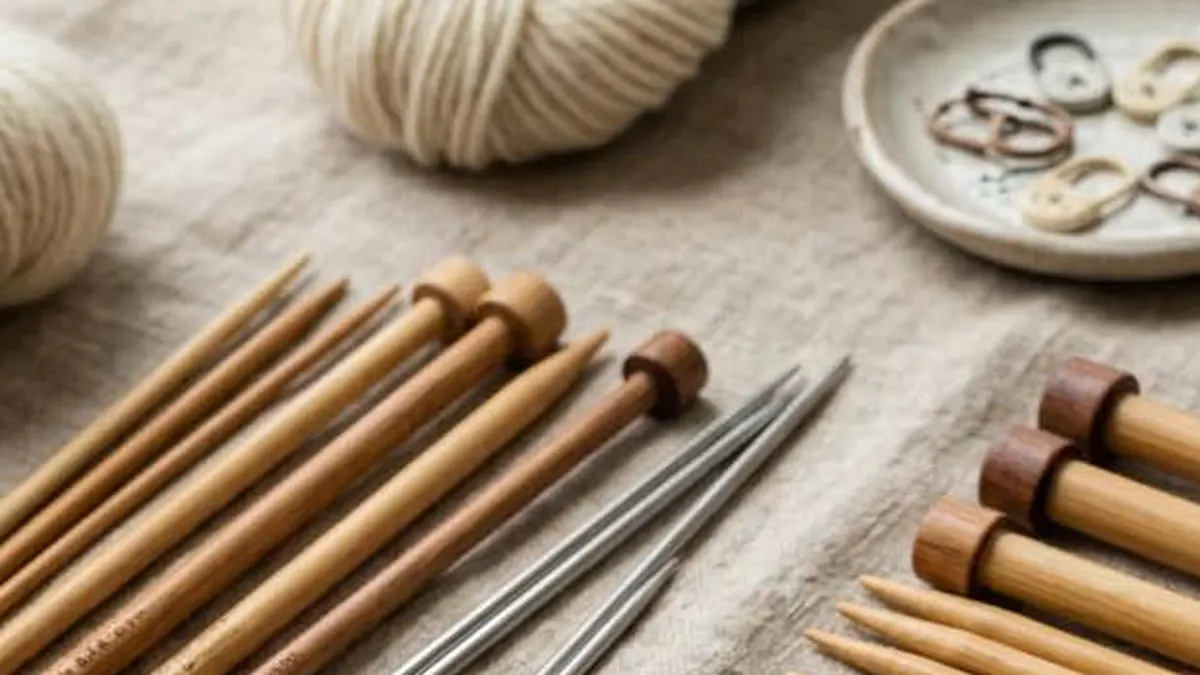
If you ask five knitters what the best knitting needles are, you will undoubtedly get five different answers. The choice of equipment is highly subjective. Nevertheless, there are clear rules of thumb on when to use metal versus wood, and when you should invest in an interchangeable set.
A Norwegian version of this page is available on Strikketips.no
Materials: wood, bamboo, metal or carbon fiber?
The material decides how securely your stitches sit on the needle, how fast you get through a round, and how much abuse the needle survives in your project bag. The table below sums up the three materials actually in use today:
| Material | Grip | Speed | Noise | Durability | Best for |
|---|---|---|---|---|---|
| Wood and bamboo | High | Slowest | Nearly silent | Thin needles can snap | Beginners, loose knitters, and slippery yarns like silk or viscose |
| Metal | Low | Fastest | Noticeable clicking | Practically never breaks | Experienced knitters, tight knitters, and grabby yarns like rustic wool |
| Carbon fiber | Medium | Second fastest | Medium | Withstands the most bending | Knitters who want one set that lasts, and who like sharp brass tips |
High grip keeps stitches from slipping off by accident, but it also slows your knitting down – so the choice between wood and metal is really a trade-off between control and speed. If you are unsure, start with wood or bamboo: it is easier to get faster with secure stitches than to rescue stitches you never noticed falling off.
Construction and ergonomics
Today, the vast majority of all projects are knitted on circular needles. Even flat scarves! Short circulars (16 inches / 40 cm) are used for cowls and hats, while long ones (32–40 inches / 80–100 cm) are used for sweater bodies and the Magic Loop technique. Knit on circulars wherever you can, and let the fabric rest in your lap for the best possible ergonomics.
Circulars, DPNs or straights?
Even though circulars have taken over most of the work, double-pointed needles and straight needles still have their natural place in the project bag:
- Circular needles: Best for almost everything – sweater bodies, shawls, blankets and even flat pieces. With the Magic Loop technique you can knit narrow tubes like sleeves and hats on one long circular, without switching needles halfway through.
- Double-pointed needles (DPNs): Still a good choice for small-diameter tubes like socks, mittens and hat crowns, where many knitters find four or five short needles faster and easier to keep track of than Magic Loop.
- Straight needles: The old-fashioned long needles you tuck under your arm are almost completely phased out, because they give poor ergonomics and put all the weight on your arms. They still work fine for simple flat projects like scarves if that is what you have on hand.
If you know knitting will be your long-term hobby, an interchangeable set is worth its weight in gold. You get loose tips and loose cables that screw together, so you can change length in seconds – instead of buying one fixed needle per length in every size.
Needle size: why thickness matters so much
Needle diameter (measured in mm) controls your stitch size and therefore your gauge. Needles that are too thin produce tight, stiff stitches, while needles that are too thick produce loose, sloppy stitches that can leave a garment shapeless and full of gaps. Always start with the needle size a pattern recommends, knit a gauge swatch, and size up or down from there until you match gauge – never the other way around.
Needle sizing is labeled differently around the world (mm, US sizes, and UK sizes don't always line up 1:1), so use our needle size converter whenever a pattern uses a different scale than the one printed on your needles.
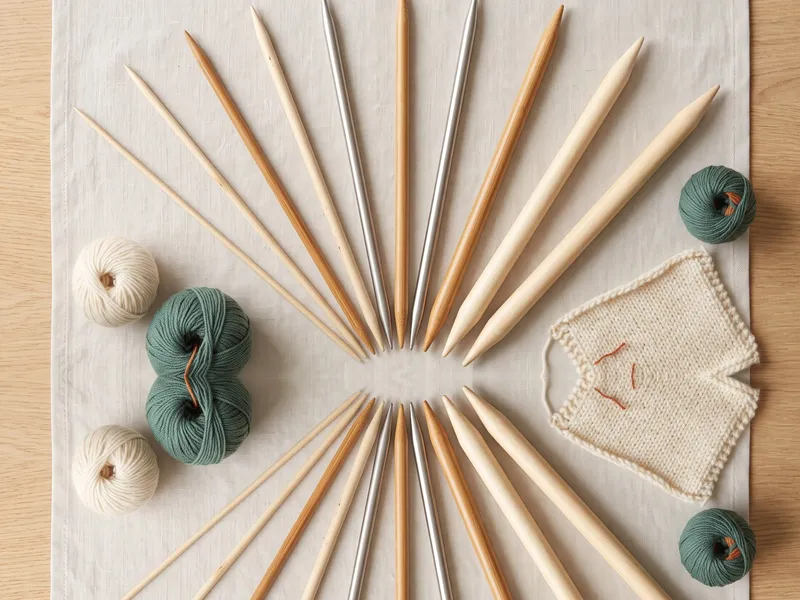
Caring for your knitting needles
Good needles last for years if you treat them well. A few simple habits go a long way:
- Wax wooden needles occasionally with a little beeswax or furniture polish to keep the surface smooth – dry wood can get rough and start gripping the yarn too hard over time.
- Avoid big temperature swings for wood and bamboo needles. Don't leave them in a hot car or direct sunlight, as this can make the wood brittle and prone to cracking.
- Dry metal needles promptly if they get wet, so they don't rust or lose their surface finish.
- Oil the joins on interchangeable circular needles from time to time, so the tips screw on and off the cables smoothly instead of seizing up.
- Store needles together in a needle case or roll with individual pockets, rather than loose in a drawer. This protects sharp tips from getting dull or bent.
Frequently asked questions
Should beginners choose wood or metal?
Wood or bamboo! Such needles have slightly more friction ('grip'), which prevents stitches from slipping off easily. This is a huge advantage when you haven't fully mastered your tension (gauge) yet.
Why use circular needles when knitting flat?
Many choose to use circular needles even for knitting flat (scarves, blankets, etc.). This distributes the weight of the knitted item down into your lap, instead of your arms having to support the full weight like on long, straight needles. It saves your shoulders and neck a lot of strain.
Are interchangeable circular needles worth the price?
Yes, for the majority of avid knitters, they are an extremely good investment. You don't have to buy a new 32-inch size 6 needle, then a 16-inch size 6 needle. You simply change the cable. The set will last for years.
US needle numbers and their metric equivalents follow the Craft Yarn Council's knitting needle size chart. Where a US size has no exact metric twin, we give the nearest standard millimetre size.