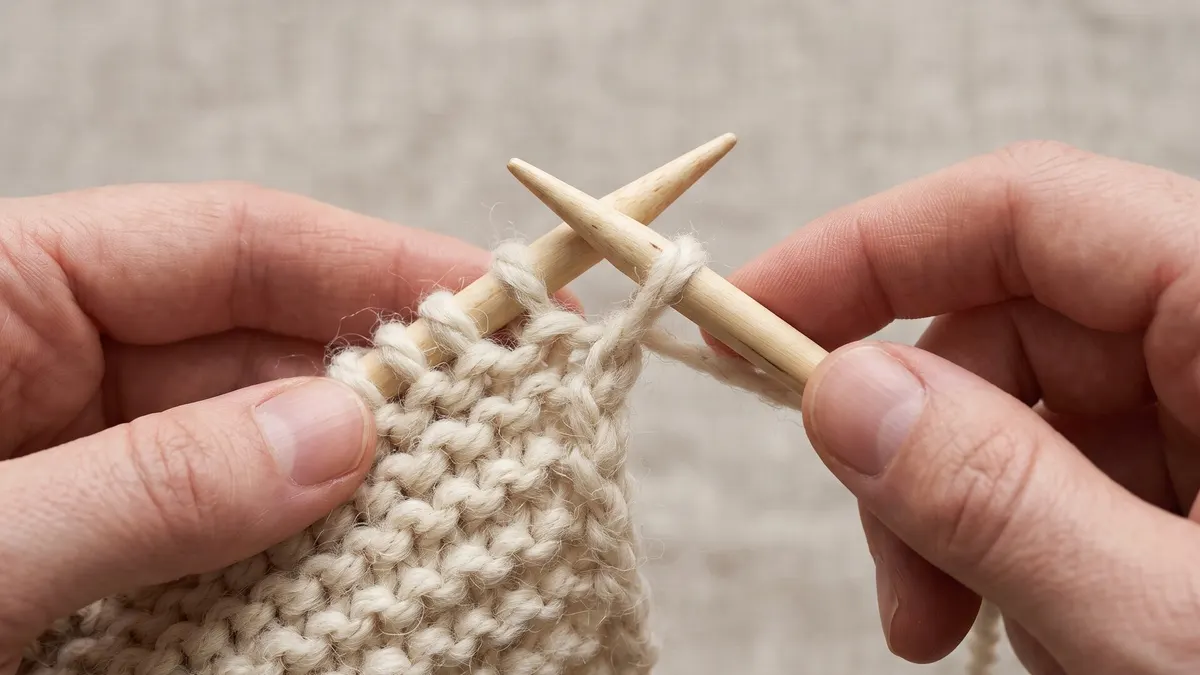
A garter stitch scarf is a common first project because you only knit, back and forth. This pattern gives you no fixed stitch count. Published scarf patterns use anything from 7 to 16 stitches per 4 inches, depending on the yarn. What they agree on is the method. So you knit a swatch, work out your own cast-on, and follow the steps below.
Pattern at a glance
A Norwegian version of this page is available on Strikketips.no
Yarn, Needles and Notions
- Yarn: any weight. The patterns we compared use everything from worsted to super bulky. How much you need depends on the yarn and the size; the table further down shows what each pattern lists.
- Needles: straight or circular needles in the size your yarn label suggests. You work back and forth, so either works.
- Notions: tapestry needle, tape measure and scissors.
- Skills: casting on, the knit stitch and binding off.
Work Out Your Cast-On
- Knit a swatch in garter stitch (knit every row) on the needles you plan to use, until it is roughly square.
- Lay it flat and count the stitches over 4 inches without stretching it. None of the patterns we compared say whether their gauge was measured before or after washing, so measure the swatch the way you plan to wear the scarf. Our gauge guide explains how to count.
- Decide how wide the scarf should be. The patterns we compared are 6 to 9.5 in15 to 24 cm wide.
- Work it out: width in inches × stitches per 4 inches ÷ 4. Round to a whole number.
Worked example
Width 8 in20 cm, gauge 16 stitches per 4 in10 cm in garter stitch: 8 × 16 ÷ 4 = 32 stitches. This is an example of the arithmetic, not a recommended gauge.
The Pattern
- 01
Cast on
Cast on the number you worked out. Four of the five patterns we compared use a long-tail cast-on.
- 02
Knit every row
Knit all stitches, turn the work, and knit all stitches again. Two rows make one ridge. Both sides of the scarf look the same.
Optional: for a neater edge, slip the first stitch of every row purlwise with the yarn in front, and knit the rest.
- 03
Knit to length
Keep going until the scarf is as long as you want, measured from the cast-on edge with the work lying flat. Make sure you have yarn left for the bind-off.
- 04
Bind off loosely
Bind off all stitches knitwise and loosely, so the end is not narrower than the cast-on edge. Cut the yarn and pull it through the last stitch.
- 05
Weave in ends
Weave in both tails with a tapestry needle and trim. For fringe, All About Ami and Sarah Maker show how to knot it into the short ends.
What Published Patterns Use
All five knit every row and bind off at the end. The numbers below are as each pattern gives them, and show why we give no fixed stitch count.
| Pattern | Yarn / needle | Gauge (garter) | Cast-on | Finished size | Yarn |
|---|---|---|---|---|---|
| ChristaCoDesign | Worsted, US 8 | 16 sts / 4 in | 24 | 6 × 60 in15 × 152.5 cm | 470 yd430 m |
| Sarah Maker | Bulky, US 10.5 | 11 sts / 4 in | 24 | 8 × 72 in20 × 183 cm | 3 skeins of 4.4 oz125 g |
| Handy Little Me | Super bulky, US 13 | 10 sts / 4 in | 25 | 7 × 98.5 in18 × 250 cm | 405 yd370 m |
| Brome Fields | Super bulky, US 13 | 9 sts / 4 in | 19 | 8 × 85 in20 × 219 cm | 305–315 yd279–288 m |
| All About Ami | Held double (super bulky + bulky), US 1915 mm | 7 sts / 4 in | 16 | 9.5 × 70.5 in24 × 179 cm | 212 yd194 m super bulky + 1 skein bulky |
If you would rather knit one of these patterns in a different yarn, the gauge calculator compares your gauge with the pattern's, and the yarn substitution calculator converts the amount.
What This Pattern Does Not Promise
The method, cast-on worked out from gauge and width, knit every row, bind off at the end, is shared by the patterns in the table. The worked example is our own arithmetic, and this scarf has not been test-knit. For four of the five, cast-on, gauge and width roughly agree with the arithmetic above. For Handy Little Me, 25 stitches at 10 stitches per 4 inches gives about 10 inches, while the pattern lists 7 inches. We don't know why, and it is one reason to trust your own swatch. We give no fixed yarn amount because it depends on yarn, width and length.
Method cross-checked against ChristaCoDesign (Easy Knit Scarf), Sarah Maker (Garter Stitch Scarf), Handy Little Me (Garter Stitch Scarf), Brome Fields (Long Winter's Nap) and All About Ami (Simple Garter Stitch Scarf), all read 2026-11-16.
FAQ
How many stitches do I cast on for a scarf?
It depends on your yarn and how wide you want it. Multiply the width in inches by your stitches per 4 inches from the swatch, and divide by 4. At 16 stitches per 4 in10 cm and a width of 8 in20 cm, that is 32 stitches.
How long should a scarf be?
The five patterns we compared run from about 60 in152 cm to 98.5 in250 cm, so length is a matter of taste. A scarf you already like is the easiest guide.
Does garter stitch curl at the edges?
No. Handy Little Me notes that garter stitch lies flat and does not curl at the edges the way stockinette does, so the scarf needs no separate border.
How do I get a neater edge?
Slip the first stitch of every row purlwise with the yarn in front, then knit the rest. Sarah Maker does it this way. Brome Fields shows an optional variant that also slips the last stitch.